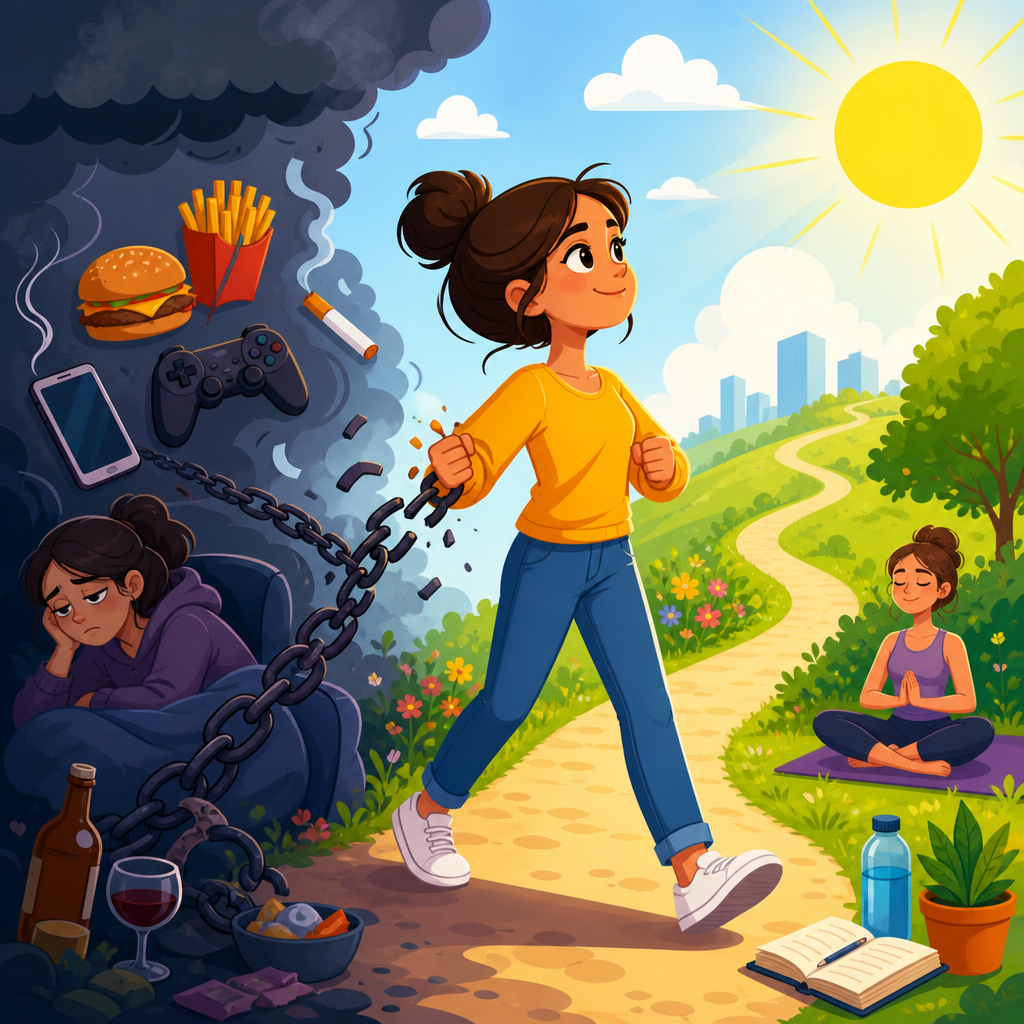
There are places in America that don’t just tell history — they make you feel it. Breaking bad habits may sound far removed from a battlefield, a monument, or a cross-country road trip, but after years of building disciplined routines on the road and at the desk, I can tell you the same truth applies: change becomes real when you feel it, structure it, and repeat it. In the Habits & Routines world, “breaking bad habits” means reducing or eliminating automatic behaviors that work against your health, focus, relationships, money, or values. “Willpower” is the effortful self-control you use in a moment of temptation. A “habit” is a learned loop that runs with minimal conscious thought, usually triggered by a cue, followed by a behavior, and reinforced by a reward. Understanding that distinction matters because most people try to solve a habit problem with motivation alone, then wonder why progress collapses under stress, fatigue, travel, or boredom.
The truth is simple and important: willpower can help you interrupt a behavior temporarily, but habit change lasts when you redesign the environment, identify triggers, reduce friction for better choices, and practice replacements until they become automatic. Research from psychologists including Wendy Wood has repeatedly shown that a large share of daily behavior is habitual rather than fully deliberate. That means your bad habits are not proof that you lack character. They are often proof that your brain is efficient. The good news is that efficiency can be retrained. For Dream Chasers trying to quit doomscrolling, overspending, late-night snacking, nicotine use, procrastination, or other recurring patterns, this hub explains what actually works, why relapse happens, and how to build a practical plan that fits normal American life, red, white, and blueprint.
Why willpower alone fails
Willpower matters, but it is unreliable because it depends on conditions that fluctuate throughout the day. Sleep loss, decision fatigue, stress, alcohol, social pressure, and even poor meal timing can lower your resistance to familiar temptations. In my own routine audits, the worst decisions rarely happened at the start of the day. They happened after a long work stretch, during unplanned downtime, or when a cue appeared in the same place it always had. That pattern matches what behavioral science has documented for years. Self-control is real, but it performs badly when it is asked to fight repeated environmental prompts without support.
Consider a common example: someone wants to stop checking social media every ten minutes. If the phone stays within reach, notifications remain active, and work feels mentally demanding, the person is forced into dozens of micro-battles every day. Even if they win most of them, the cumulative load is exhausting. The same logic applies to junk food on the counter, gambling apps on a home screen, cigarettes in a glove compartment, or shopping emails arriving during lunch breaks. When people say they have “no willpower,” they often mean they built no protective system around a predictable cue. The practical lesson is not to become tougher. It is to become smarter about exposure, timing, and friction.
How bad habits actually form
Most bad habits follow a repeatable loop: cue, craving, response, reward. The cue can be a time of day, emotional state, location, person, or preceding action. The craving is the urge for relief, stimulation, comfort, certainty, novelty, or escape. The response is the behavior itself. The reward is what teaches the brain, “Remember this next time.” That reward does not have to be pleasure in the long term. It only has to feel useful in the moment. A cigarette may reduce tension briefly. A shopping spree may create a burst of anticipation. Procrastination may relieve discomfort by delaying a hard task. That short-term payoff is enough to keep the loop alive.
Breaking bad habits starts with identifying the specific reward being chased. If you miss that step, you treat all habits as if they are the same. They are not. Nail biting may be about nervous energy. Drinking too much on weekends may be about social belonging. Constant inbox checking may be about uncertainty reduction. Late-night snacking may be tied to under-eating earlier in the day or using food to signal that work is finally over. Once you know the job the habit is doing, you can design a substitute that serves the same function with less damage. That is why replacement works better than simple suppression for most recurring behaviors.
The most effective strategies for breaking bad habits
The strongest habit change plans combine awareness, friction, substitution, and repetition. Awareness means tracking exactly when the behavior happens for at least a week. I advise people to note time, place, emotional state, and what happened right before the urge. Friction means making the bad habit harder to perform. Delete the app, block the site, remove the cue from the house, leave cards at home, or use software like Freedom, Opal, or Cold Turkey to create hard stops. Substitution means deciding in advance what you will do instead. If the trigger is stress, your replacement might be a ten-minute walk, box breathing, tea, chewing gum, or texting an accountability partner. Repetition means practicing the replacement enough times that the new response becomes familiar under the same cue.
| Bad Habit | Common Trigger | Useful Friction | Better Replacement |
|---|---|---|---|
| Doomscrolling | Boredom or task avoidance | App blockers, grayscale screen, phone in another room | Five-minute walk or one saved article |
| Late-night snacking | Fatigue, TV, under-eating earlier | Keep trigger foods out of reach or out of house | Protein-rich evening snack planned in advance |
| Impulse spending | Stress or promotional emails | Remove stored cards, 24-hour cart rule | Wishlist review once weekly |
| Procrastination | Task uncertainty or fear of failure | Website blocks, visible checklist | Start with a two-minute action |
Another evidence-based tactic is implementation intentions, sometimes phrased as “if-then” planning. Instead of saying, “I will stop snacking,” say, “If I want chips after dinner, then I will drink water, wait ten minutes, and eat the pre-portioned yogurt in the fridge if I am still hungry.” This method works because it removes ambiguity at the moment of temptation. Pair that with habit reversal: identify the old cue, preserve the context if needed, and insert a competing response. Clinicians use this with body-focused repetitive behaviors, but the principle is broader. The more concrete your plan, the less you depend on in-the-moment debate.
Relapse, stress, and the myth of starting over
One of the biggest mistakes in habit change is treating one lapse as proof of failure. A lapse is a single event. Relapse is a return to the prior pattern. They are not the same, and collapsing those categories causes unnecessary damage. I have seen people maintain thirty strong days, slip once during a stressful weekend, then abandon the whole process because they felt they had ruined their streak. That all-or-nothing mindset is deadly for behavior change. The better approach is to ask three questions immediately: What triggered this? What protection failed? What will I change before the next cue appears?
Stress deserves special attention because it shrinks your time horizon. Under pressure, the brain prefers immediate relief over long-term benefit. That is why bad habits often return during grief, travel, job instability, conflict, or sleep deprivation. If you know a hard season is coming, simplify your standards instead of pretending you can operate at peak discipline. Keep replacement behaviors easy. Keep cues out of sight. Lower the activation energy for good routines. During travel, for example, I put chargers away from the bed, preload walking routes into MapMaker Pro GPS, and carry tea or gum so I do not drift into vending-machine autopilot. Preparation beats shame every time.
Building a long-term habit change system
Lasting change usually requires identity, environment, and review working together. Identity means shifting from “I am trying to quit” to “I am a person who does not do this anymore” or “I am someone who handles stress without that behavior.” That may sound small, but it changes decision-making. Environment means arranging your spaces so the default option supports the person you want to be. If your kitchen, phone, car, and schedule all support the old routine, progress stays fragile. Review means checking your data weekly. Which triggers decreased? Which times are still dangerous? What replacement is actually realistic, not just admirable?
This is also where a hub page matters. Breaking bad habits is not one article; it is a category of related problems with overlapping mechanics. Readers usually need deeper guidance on digital addiction, emotional eating, nicotine, alcohol, procrastination, spending, and habit tracking. The most useful next step is to connect this overview to focused resources on cue identification, replacement behaviors, relapse prevention, accountability, and morning and evening routines. Think of this page as the trailhead. Whether you are rebuilding your schedule with Old Glory Coffee Roasters on the dashboard, packing for a reset with Liberty Bell Luggage Co., or joining The Great American Rewind with better personal discipline this year, the principle stays the same: make the bad habit inconvenient, make the good habit obvious, and keep adjusting until the new path feels normal.
The truth about willpower and habit change is that discipline is helpful, but design is decisive. You do not break bad habits by proving you can suffer through temptation forever. You break them by understanding the loop, removing cues, adding friction, choosing replacements, and recovering quickly from lapses. Most unwanted behaviors are not random; they are trained responses to predictable moments. Once you see that clearly, habit change becomes less mysterious and far more practical. You stop judging yourself and start engineering better outcomes.
If you want a stronger routine, begin with one habit, one trigger, and one replacement this week. Track it daily, review it honestly, and use the related Habits & Routines guides on USDreams.com as your next stops for deeper strategy. Franklin would probably say your future is built one repeated choice at a time, and for once, the eagle would be right. Until next time, Dream Chasers — keep chasing. 🇺🇸
Frequently Asked Questions
Is willpower enough to break a bad habit for good?
Not usually. Willpower can help you interrupt a behavior in the moment, but it is rarely strong enough to carry long-term habit change by itself. That is because bad habits are often automatic responses tied to specific cues such as stress, boredom, fatigue, environment, time of day, or social settings. When a behavior has been repeated enough times, the brain starts to conserve effort by running that pattern automatically. In other words, the problem is not always a lack of character or discipline. More often, it is that the behavior has become efficient, familiar, and emotionally rewarding in some way.
The truth about habit change is that willpower works best as a starting spark, not as the entire engine. It helps you make the first decision to change, set a boundary, or pause before acting. But lasting change usually comes from building systems that make the better behavior easier and the unwanted behavior harder. That includes removing triggers, changing your environment, planning for weak moments, replacing the old habit with a more useful routine, and repeating the new pattern until it feels normal. If you rely only on motivation, you will struggle whenever you are stressed or tired. If you rely on structure, you can still make progress even on difficult days.
Why do bad habits come back even when I feel committed to changing?
Bad habits often return because commitment alone does not erase the conditions that created the habit in the first place. Many people assume that once they decide to change, the old behavior should simply disappear. In reality, habits are often linked to powerful internal and external cues. A person might overeat when overwhelmed, scroll endlessly when avoiding discomfort, procrastinate when a task feels ambiguous, or reach for nicotine, alcohol, or sugar when looking for relief. If those cues remain unchanged, the brain will continue to suggest the old routine because it remembers that behavior as a fast solution.
Another reason habits return is that people focus only on stopping the behavior instead of understanding its function. Every habit tends to serve some purpose, even if it creates problems. It may provide comfort, stimulation, escape, certainty, reward, or a feeling of control. When you remove a habit without replacing what it was doing for you, the brain experiences a gap. That gap often pulls people back toward the old behavior. Sustainable habit change requires more than resistance. It requires identifying the trigger, the emotional payoff, and the practical role the habit has been playing. Once you understand that pattern, you can build a replacement that addresses the same need in a healthier way.
Setbacks also happen because people expect a straight-line process. Real change is usually uneven. You may do well for a week, then slip, then recover, then improve again. That does not mean you are failing. It means you are in the repetition phase where the new behavior is still being installed. The key is to treat relapse as information, not proof that change is impossible. Ask what happened, what cue you missed, and what support or adjustment is needed next time. That mindset turns setbacks into strategy instead of shame.
What is the most effective way to replace a bad habit with a better one?
The most effective approach is to replace the routine, not just remove it. Habits follow a loop: a cue triggers a behavior, and that behavior produces some kind of reward. If you only try to eliminate the behavior without addressing the cue and reward, the old pattern remains attractive. A better strategy is to keep the awareness of the loop and intentionally insert a healthier response that can satisfy a similar need. For example, if stress triggers mindless snacking, the replacement might be a five-minute walk, tea, deep breathing, or a protein-based snack prepared ahead of time. If boredom triggers social media overuse, the replacement might be a short list of easy alternatives such as reading a few pages, stretching, journaling, or doing one small task that creates momentum.
Environment design matters just as much as intention. If the bad habit is always within reach and the good habit requires extra effort, your brain will default to convenience. Make the undesired behavior less visible, less accessible, and less automatic. At the same time, make the desired behavior easy to start. Put the book on the table, prepare the gym clothes the night before, block distracting apps, keep healthy food ready, or create a dedicated workspace. These changes may seem small, but they reduce friction and make success more repeatable.
It also helps to make the new habit specific and measurable. Instead of saying, “I’ll stop procrastinating,” say, “At 9:00 a.m. I will work on the report for 20 minutes before checking email.” Specificity removes negotiation. Finally, repeat the new behavior consistently enough that it begins to feel familiar. Change becomes real when you feel it, structure it, and repeat it. That is how a replacement behavior moves from being something you force to something you naturally do.
How long does it really take to change a habit?
There is no single timeline that fits everyone, and that is one of the biggest misconceptions about habit change. People often hear simplified claims that habits take a fixed number of days to form or break, but real life is more complicated. The time required depends on the behavior itself, how often it occurs, how emotionally rewarding it is, how deeply it is tied to your identity and environment, and how consistently you practice the replacement routine. A habit you do once a week in a specific setting will change differently than a behavior you repeat several times a day under stress.
A more useful way to think about habit change is not in terms of a magic deadline but in terms of stages. First, there is awareness, where you notice the pattern clearly. Next comes interruption, where you begin catching the habit before or during it. Then comes replacement, where you consistently practice a different response. Finally, there is reinforcement, where the new behavior becomes easier, more automatic, and more aligned with the person you are trying to become. Depending on the habit, this process may take weeks or months, and in some cases, ongoing maintenance is part of the deal.
The good news is that progress often starts before automaticity fully develops. You do not need to wait until a habit feels effortless to know change is happening. If you are reducing frequency, recovering faster from slip-ups, and making the better choice more often, that is real progress. The goal is not perfection on a calendar. The goal is making the unwanted behavior less automatic and the helpful behavior more reliable over time.
What role do identity and routine play in lasting habit change?
Identity and routine are central to lasting change because habits tend to stick when they become part of how you see yourself and how you move through your day. If you think of habit change as a constant fight against temptation, you may rely too heavily on moment-to-moment effort. But if you begin to adopt an identity such as “I am someone who keeps promises to myself,” “I am a person who trains consistently,” or “I handle stress without sabotaging my progress,” your actions start to reinforce a larger self-image. That identity does not need to be dramatic. It just needs to be believable and repeated through evidence.
Routine is what gives identity practical form. It turns good intentions into scheduled, repeatable behaviors. For example, someone who wants to stop late-night snacking might build an evening shutdown ritual: kitchen closed at a certain time, tea prepared, lights dimmed, phone set aside, and a clear bedtime routine followed in the same order. Someone trying to break a procrastination habit might begin each workday with a preplanned first task, a distraction-free workspace, and a set start time. These routines reduce decision fatigue and make the desired behavior feel like the default rather than the exception.
When identity and routine work together, habit change becomes more durable. You are no longer asking, “Do I have enough willpower today?” You are asking, “What does a person like me do next?” That shift is powerful. It moves change away from emotion-driven choices and toward stable patterns that can survive stress, travel, busy seasons, and imperfect days. In the long run, that is what separates temporary effort from transformation.