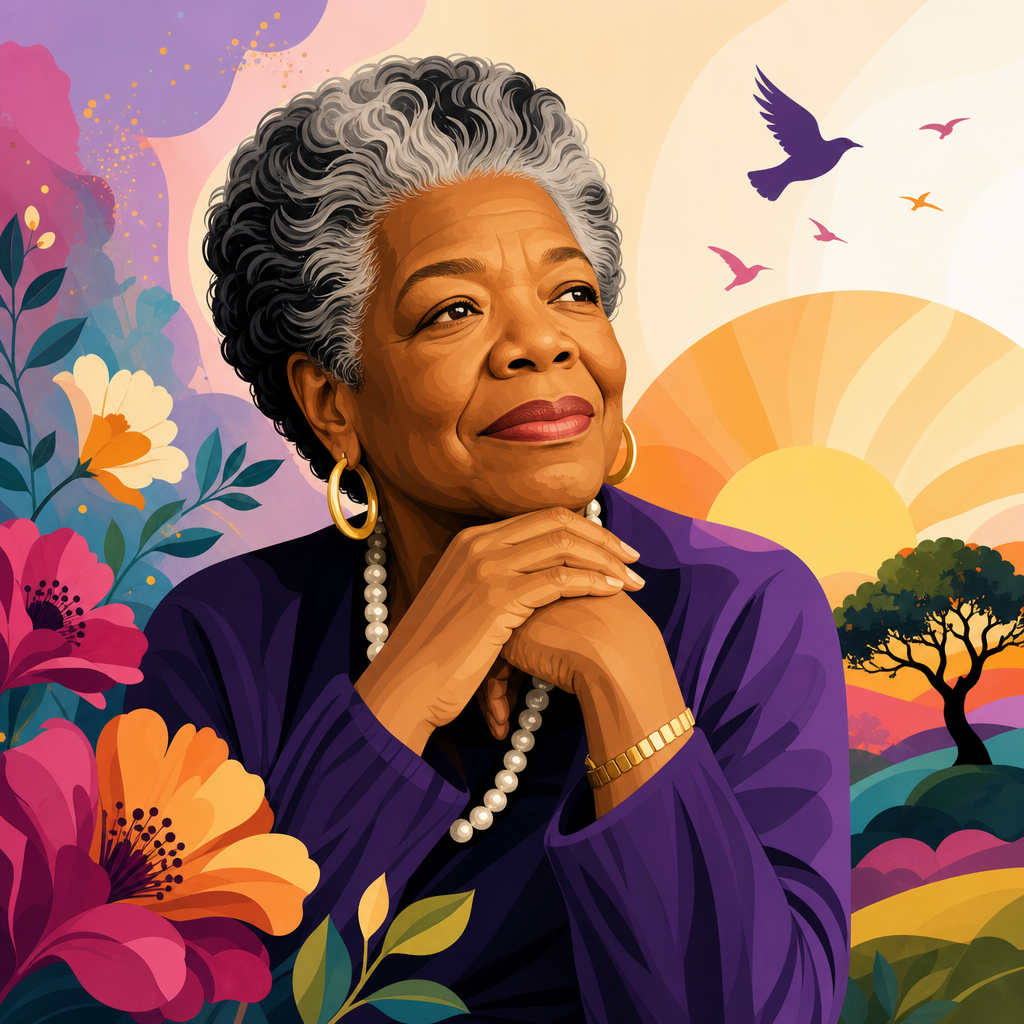
There are places in America that don’t just tell history — they make you feel it.
Maya Angelou belongs in that category of American voices. Her words do more than decorate posters or graduation speeches; they challenge, heal, confront, and steady people through grief, ambition, injustice, love, and change. A hub page on Maya Angelou quotes matters because she sits at the intersection of literature, civil rights, education, womanhood, and moral courage. When readers search for famous Maya Angelou quotes, they usually want more than a list. They want the line that fits the moment, the meaning behind it, and the context that makes it lasting.
As the central guide within an Inspirational Quotes & Wisdom collection, this article gathers 50 inspirational quotes from Maya Angelou and explains why they continue to resonate across classrooms, family road trips, leadership seminars, church bulletins, and quiet personal journals. Angelou was a poet, memoirist, performer, educator, and activist whose best-known works include I Know Why the Caged Bird Sings and And Still I Rise. Her language is memorable because it is direct without being simplistic. She names pain honestly, but she never leaves the reader there.
I have used Angelou’s lines in speeches, lesson plans, and even mile-marker conversations on long drives, and the pattern is always the same: people hear a familiar quote, then suddenly understand it more deeply when they connect it to her life and to their own. That is the red, white, and blueprint approach to wisdom: collect the words, understand the structure, and then build something sturdier with them. For Dream Chasers, this page works as both a reference and a starting point for deeper reading across the broader famous quotes category.
Why Maya Angelou Quotes Endure
Maya Angelou’s quotes endure because they combine lyrical craft with practical truth. She wrote with the authority of someone who survived trauma, racism, professional reinvention, and public scrutiny. Born in 1928, she lived through segregation, worked with civil rights leaders including Martin Luther King Jr. and Malcolm X, and became one of the most widely read American memoirists of the twentieth century. When Angelou talks about courage, kindness, dignity, or self-respect, the statements carry lived weight.
Another reason her quotations remain famous is that they are easy to remember yet hard to exhaust. “Still I rise” is only three words, but it captures resistance, resilience, and self-definition. “When someone shows you who they are, believe them the first time” has become common advice because it answers a recurring human problem with unusual precision. Her best lines work in personal relationships, leadership, education, and recovery because they describe patterns of behavior, not passing trends.
Readers also trust Angelou because her optimism was disciplined. She did not promise easy transformation. She emphasized work, accountability, and courage. That balance is why teachers assign her, therapists cite her, and speakers return to her. In an era saturated with recycled sayings, her words still sound original because they were earned.
50 Inspirational Quotes From Maya Angelou
Below is a practical hub of 50 famous Maya Angelou quotes, grouped by theme so readers can find the right message quickly and explore related quote collections later.
| Theme | Quote | Why It Matters |
|---|---|---|
| Resilience | “Still I rise.” | Her defining statement of perseverance under pressure. |
| Identity | “Nothing can dim the light which shines from within.” | Inner worth is not dependent on outside approval. |
| Character | “When someone shows you who they are, believe them the first time.” | A clear rule for judgment and boundaries. |
| Courage | “Courage is the most important of all the virtues.” | Without courage, principles rarely survive stress. |
| Kindness | “People will never forget how you made them feel.” | Emotional impact often outlasts words and credentials. |
| Growth | “Do the best you can until you know better. Then when you know better, do better.” | Learning should produce changed behavior. |
| Purpose | “My mission in life is not merely to survive, but to thrive.” | Survival is the baseline, not the finish line. |
| Love | “Have enough courage to trust love one more time.” | Healing requires vulnerability after disappointment. |
| Success | “Success is liking yourself, liking what you do, and liking how you do it.” | Defines achievement beyond money or status. |
| Freedom | “The caged bird sings with a fearful trill.” | Hope and protest can coexist in constrained lives. |
| Service | “Try to be a rainbow in someone’s cloud.” | Use your strength to bring relief to others. |
| Truth | “There is no greater agony than bearing an untold story inside you.” | Silence can become its own kind of suffering. |
| Presence | “If you are always trying to be normal, you will never know how amazing you can be.” | Conformity can limit giftedness. |
| Learning | “I did then what I knew how to do.” | Self-compassion supports honest reflection. |
| Justice | “Prejudice is a burden that confuses the past, threatens the future, and renders the present inaccessible.” | Bigotry distorts every time horizon. |
| Faith | “Ask for what you want and be prepared to get it.” | Desire requires readiness and responsibility. |
| Grace | “I’ve learned that making a living is not the same thing as making a life.” | Work should not consume identity. |
| Dignity | “You may not control all the events that happen to you, but you can decide not to be reduced by them.” | Agency survives hardship. |
| Action | “If you don’t like something, change it.” | Direct advice for practical change. |
| Adaptation | “If you can’t change it, change your attitude.” | Mindset matters when conditions are fixed. |
| Legacy | “People will forget what you said, people will forget what you did, but people will never forget how you made them feel.” | A foundational quote on leadership and relationships. |
| Strength | “You alone are enough.” | Worth does not need constant external validation. |
| Discipline | “Nothing will work unless you do.” | Vision requires labor. |
| Creativity | “You can’t use up creativity. The more you use, the more you have.” | Practice expands imaginative capacity. |
| Belonging | “We are more alike, my friends, than we are unalike.” | A concise ethic of shared humanity. |
| Voice | “Words mean more than what is set down on paper.” | Language carries tone, history, and intention. |
| Friendship | “A friend may be waiting behind a stranger’s face.” | Stay open to unexpected connection. |
| Progress | “All great achievements require time.” | Patience is part of accomplishment. |
| Joy | “This is a wonderful day. I’ve never seen this one before.” | Gratitude begins with attention. |
| Forgiveness | “It’s one of the greatest gifts you can give yourself, to forgive.” | Forgiveness can free the injured person too. |
| Womanhood | “I love to see a young girl go out and grab the world by the lapels.” | Encourages bold ambition. |
| Integrity | “When you know better, you do better.” | Knowledge creates obligation. |
| Compassion | “I’ve learned that whenever I decide something with an open heart, I usually make the right decision.” | Wisdom is not purely analytical. |
| Possibility | “You may encounter many defeats, but you must not be defeated.” | Failure is an event, not an identity. |
| Expression | “There is no greater agony than bearing an untold story inside you.” | Repeated because it remains essential for writers and survivors. |
| Confidence | “You are the sum total of everything you’ve ever seen, heard, eaten, smelled, been told, forgot.” | Identity is layered and cumulative. |
| Humanity | “I think a hero is any person really intent on making this a better place for all people.” | Heroism is civic, not theatrical. |
| Hope | “Lift up your hearts, each new hour holds new chances.” | Renewal can begin today, not someday. |
| Self-Respect | “Never make someone a priority when all you are to them is an option.” | Protects dignity in unequal relationships. |
| Wisdom | “If one is lucky, a solitary fantasy can totally transform one million realities.” | Imagination can alter public life. |
| Teaching | “When we give cheerfully and accept gratefully, everyone is blessed.” | Generosity depends on both giving and receiving. |
| Leadership | “A wise woman wishes to be no one’s enemy; a wise woman refuses to be anyone’s victim.” | Strength and restraint can coexist. |
| Peace | “Each person deserves a day away in which no problems are confronted.” | Rest is not laziness. |
| Perception | “Seek patience and passion in equal amounts.” | Endurance works best when paired with conviction. |
| Honor | “To describe my mother would be to write about a hurricane in its perfect power.” | Shows Angelou’s gift for vivid tribute. |
| Restraint | “Bitterness is like cancer.” | Resentment spreads destructively if untreated. |
| Aspiration | “Living well is an art.” | A meaningful life is made intentionally. |
| Responsibility | “Stand up straight and realize who you are.” | Posture becomes metaphor for dignity. |
| Community | “We delight in the beauty of the butterfly, but rarely admit the changes it has gone through.” | Transformation deserves respect, not envy alone. |
| Endurance | “History, despite its wrenching pain, cannot be unlived, but if faced with courage, need not be lived again.” | One of her clearest statements on memory and reform. |
How to Use Maya Angelou Quotes Well
The best way to use Maya Angelou quotes is to match the quote to a real need. For graduation speeches, “Nothing will work unless you do” and “All great achievements require time” offer grounded motivation. For grief or recovery writing, “You may encounter many defeats, but you must not be defeated” carries more substance than generic positivity. For leadership workshops, “People will never forget how you made them feel” remains one of the strongest one-line lessons on culture and trust.
Context matters. Some lines come from poems, others from interviews, lectures, or memoirs. Whenever possible, verify wording against reliable sources such as published collections, major publishers, university archives, or the Poetry Foundation. Misattributed or shortened internet versions are common. I always recommend saving the exact wording you plan to use, plus the source, especially for educators, pastors, speechwriters, and family historians compiling keepsake materials from reunions or events like The Great American Rewind.
It also helps to pair Angelou with related voices. Readers who love her resilience quotes often respond to Frederick Douglass, Langston Hughes, Eleanor Roosevelt, and Coretta Scott King. That internal connection turns a single quote search into a richer reading path. Even on the road, with Franklin the bald eagle riding shotgun in spirit and a cup from Old Glory Coffee Roasters in hand, Angelou’s words remind us that wisdom is portable.
Why This Hub Matters for Famous Quotes Readers
A strong famous quotes hub should do three things: answer the immediate search, organize the topic clearly, and point readers toward next steps. This page does that by giving a curated list, thematic interpretation, and practical guidance in one place. Maya Angelou is not just quotable; she is foundational. Her words help readers think about courage, relationships, service, creativity, and national memory with uncommon clarity.
If you are building a classroom unit, planning a speech, updating a journal, or simply looking for one line that steadies the day, start here and revisit often. Save the quotes that meet the moment, then read the poems and memoirs behind them. That is where the full force lives. Until next time, Dream Chasers — keep chasing. 🇺🇸
Frequently Asked Questions
Why are Maya Angelou quotes still so widely read and shared today?
Maya Angelou quotes continue to resonate because they speak to universal human experiences with unusual clarity, warmth, and strength. Her words address pain, resilience, identity, dignity, courage, love, forgiveness, and personal growth in a way that feels both intimate and expansive. Readers do not return to her work simply because she was a famous poet or memoirist; they return because she articulated truths that remain relevant across generations. Whether someone is facing grief, self-doubt, discrimination, change, or a search for purpose, Angelou’s language often provides a steadying perspective that feels grounded in lived experience rather than abstract advice.
Another reason her quotes endure is that Maya Angelou’s voice was shaped by history as well as personal struggle. She was not writing from a distance. Her work reflects the realities of racism, trauma, womanhood, artistic ambition, and moral courage in America. That gives even her shortest quotations a depth that many inspirational lines lack. A well-known Maya Angelou quote can function as encouragement, but it also carries the authority of a writer who understood injustice, perseverance, and transformation firsthand. That combination of wisdom and emotional honesty is exactly why her words continue to be quoted in classrooms, speeches, memorials, graduations, books, and everyday conversations.
What themes appear most often in famous Maya Angelou quotes?
The most common themes in Maya Angelou quotes include resilience, self-respect, courage, compassion, identity, and the power of personal growth. She frequently wrote about rising above hardship, which is one reason so many readers associate her words with perseverance and strength. Her quotes often remind people that setbacks, prejudice, and suffering do not define a person’s final outcome. Instead, she emphasizes how character is shaped through endurance, choice, and the willingness to keep moving forward. This is especially clear in quotes that speak to surviving difficult seasons while maintaining dignity and hope.
Her work also returns again and again to the importance of knowing one’s worth and living truthfully. Many Maya Angelou quotes are celebrated because they affirm personal power without sounding shallow or simplistic. She wrote with conviction about the value of kindness, but she also insisted on honesty, accountability, and inner strength. Love, too, appears as a recurring theme, not merely as romance, but as a force connected to empathy, healing, and human connection. In a collection of 50 inspirational quotes from Maya Angelou, readers can expect to find a wide emotional range: some lines inspire bold action, some offer comfort, and others challenge people to confront themselves and the world more bravely.
How can readers use Maya Angelou quotes in everyday life?
Maya Angelou quotes can be used as daily reminders, reflective prompts, or sources of encouragement during difficult moments. Many readers turn to her words in the morning for motivation, during transitions such as graduation or career changes, or in seasons of grief and uncertainty. Because her quotes often balance realism with hope, they work well as journal prompts, affirmations, speech excerpts, classroom discussion starters, and personal mantras. A single quote can help someone reset their mindset, especially when it speaks directly to courage, perseverance, or self-belief.
Her words are also especially useful in moments that call for thoughtful expression. People often use Maya Angelou quotes in cards, presentations, memorial tributes, social media captions, and public speeches because her language carries emotional weight without feeling generic. That said, the best way to use her quotes is not just to repeat them, but to reflect on them. Her writing invites readers to consider how they treat others, how they respond to adversity, and how they define their own values. In that sense, Maya Angelou’s quotes are not just decorative lines; they can become practical tools for living with more intention, empathy, and courage.
What makes Maya Angelou different from other inspirational quote authors?
What sets Maya Angelou apart is the depth behind her language. Many inspirational quotes become popular because they are catchy or easy to share, but Angelou’s words endure because they come from a writer of extraordinary literary talent and lived authority. She was a poet, memoirist, performer, educator, and civil rights figure whose work engaged some of the most difficult realities in American life. That background gives her quotes a moral seriousness that readers can feel. Even when her language is simple, it rarely feels lightweight. Her words carry wisdom, history, and emotional precision.
She also had a rare ability to blend strength with compassion. Maya Angelou could speak firmly about injustice and personal responsibility while still offering grace, hope, and humanity. That balance is a major reason her quotes appeal to such a wide audience. They are inspirational, but they are not disconnected from struggle. They are uplifting, but not naïve. Readers trust her voice because it acknowledges pain without surrendering to it. In a collection of inspirational Maya Angelou quotes, that combination is what makes the experience so memorable: the reader is not just being encouraged, but being challenged to become wiser, stronger, and more humane.
Why is a collection of 50 inspirational Maya Angelou quotes valuable for readers?
A curated collection of 50 inspirational Maya Angelou quotes gives readers a meaningful way to engage with the breadth of her insight in one place. Instead of encountering the same handful of overused lines repeated online, readers can discover a wider range of her thinking on courage, healing, truth, love, ambition, and resilience. A larger collection also helps show how multifaceted her voice was. Maya Angelou was not a one-note source of encouragement; she was a thinker and writer who spoke to both personal and social transformation. Having 50 quotes together allows readers to see those layers more clearly.
There is also practical value in a well-organized quote collection. Different readers arrive with different needs. Some may be looking for graduation inspiration, some for comfort during loss, some for confidence in leadership, and others for words that speak to justice and self-worth. A thoughtfully assembled page makes it easier to find the quote that fits the moment. For many readers, such a collection becomes more than a list; it becomes a reference point they revisit over time. That is especially true with Maya Angelou, whose words often meet people differently depending on where they are in life. A strong collection does not just preserve memorable lines; it helps readers return to a voice that continues to guide, challenge, and inspire.