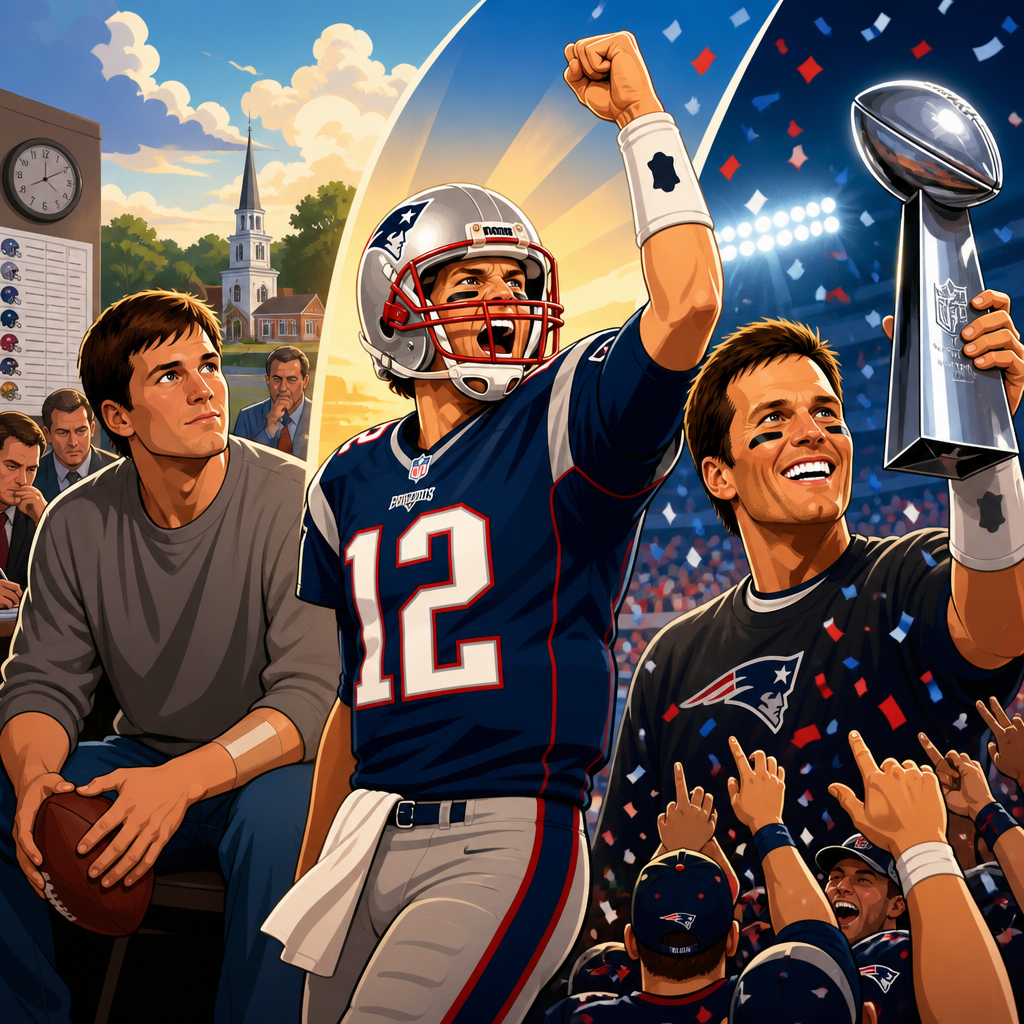
There are places in America that don’t just tell history — they make you feel it. Tom Brady’s story belongs in that category because it is more than a football biography; it is a case study in preparation, resilience, leadership, reinvention, and sustained excellence under pressure. For readers exploring athlete and performer journeys, Brady offers one of the clearest examples of how an overlooked prospect can become the benchmark for an entire field. His rise from a lightly recruited high school player to a six-time Super Bowl winner in New England, and then a seventh champion in Tampa Bay, changed how coaches, analysts, and fans define greatness.
When people call Brady the GOAT, they mean the Greatest of All Time, a label earned through measurable production and unusual longevity. Across 23 NFL seasons, he set records in passing yards, touchdown passes, wins by a starting quarterback, playoff victories, and Super Bowl appearances. Yet statistics alone miss the full lesson. Brady’s rise matters because it shows how elite careers are usually built less on raw flash than on repeatable habits: film study, situational awareness, footwork, recovery, emotional control, and the ability to improve teammates. I have covered enough sports-history stories to know that truly durable greatness is almost always red, white, and blueprint: intentional, structured, and executed over years rather than moments.
As a hub article for athlete and performer journeys, this guide traces the turning points that made Brady’s career exceptional and explains why his example belongs alongside other success stories built on persistence. It also answers the questions most readers bring to the topic: Was Tom Brady really an underdog? What made him different from more gifted quarterbacks? How did he sustain elite play into his forties? What can students, coaches, entrepreneurs, and Dream Chasers learn from his path? The short answer is simple. Brady was underestimated early, maximized every opening, mastered details others ignored, and kept adapting long after most champions decline. That is why his career remains one of the strongest modern studies in long-term performance.
Early setbacks shaped the competitor
Tom Brady was born in San Mateo, California, in 1977 and grew up a fan of Joe Montana and the San Francisco 49ers. At Junípero Serra High School, he played football and baseball, showing promise but not the can’t-miss profile recruiters chase. He was not the nation’s top quarterback prospect, and his athletic testing never created buzz the way stronger, faster passers often do. Even so, his early years revealed traits that later defined him: patience in the pocket, accuracy on timing routes, and competitive calm in tense moments. Those attributes are harder to package than arm strength, but they often age better.
At the University of Michigan, Brady faced another familiar obstacle: he had to fight for playing time. He started only late in his college career after competing with highly touted recruits, including Drew Henson. Michigan’s staff used a platoon system at one point, a frustrating arrangement for any quarterback trying to establish rhythm. Brady responded by improving command of the offense, protecting the football, and delivering in pressure situations. In the 1999 Citrus Bowl against Alabama, he led multiple scoring drives and helped engineer an overtime win. That performance did not erase scouting concerns, but it reinforced a critical pattern. When the stakes rose, Brady’s decision-making usually got cleaner, not shakier.
The 2000 NFL Draft remains one of the most replayed chapters in his story. Brady lasted until pick 199 in the sixth round, selected by the New England Patriots after six quarterbacks had already gone. The scouting profile was famously unflattering. At the NFL Combine, his 40-yard dash and physique fueled skepticism, and his now-iconic shirtless photo became shorthand for perceived athletic limitations. In retrospect, the evaluation process overvalued visible traits and undervalued anticipation, processing speed, and competitive consistency. Brady entered the league with no entitlement and no guarantee of meaningful snaps, which is exactly where many underdog stories either stall or harden into something stronger.
New England turned opportunity into dynasty
Brady began as a backup to Drew Bledsoe, one of the league’s established franchise quarterbacks. His first major opening came in 2001 after Bledsoe suffered a serious injury against the New York Jets. Brady did not step into a perfect environment; he stepped into a team with defensive discipline, strong coaching from Bill Belichick, and an offense that needed efficient management more than hero-ball. That fit mattered. Brady quickly showed he could deliver the right throw at the right time, avoid catastrophic mistakes, and run situational football at a championship level. New England finished 11-3 in games he started that regular season.
The Patriots’ victory in Super Bowl XXXVI over the heavily favored St. Louis Rams established Brady as more than a temporary replacement. With 1:30 remaining and the score tied, he led a composed final drive that set up Adam Vinatieri’s game-winning field goal. That sequence became a signature template for his career: process the defense pre-snap, take efficient gains, control the clock, and finish without panic. From there, the Patriots built a dynasty that won three Super Bowls in four seasons, adding titles after the 2003 and 2004 campaigns. Brady was not yet the statistical machine he would later become, but he was already the league’s most dependable pressure quarterback.
One reason the dynasty lasted is that Brady evolved as the roster changed. Early Patriots teams leaned on defense, field position, and low-turnover football. Later versions gave Brady more responsibility at the line of scrimmage, more spread concepts, and greater freedom to attack favorable matchups. His partnership with Belichick worked because both prized versatility and game-specific planning. They rarely treated winning as a fixed formula. Against one opponent, the Patriots might throw quickly to neutralize a pass rush. Against another, they might lean on tight ends, option routes, or no-huddle tempo to force coverage errors. Brady’s ability to absorb and execute those shifts separated him from quarterbacks who thrived only in static systems.
What made Brady different from more gifted athletes
The simplest answer is processing. Brady read defenses rapidly, understood leverage, manipulated safeties with his eyes, and delivered the ball before windows fully opened. He was not the strongest runner or the biggest improviser, but he consistently won the half-second battle that defines quarterback play. Mechanics also mattered. His footwork in the pocket allowed him to reset efficiently, maintain throwing posture under interior pressure, and keep timing intact. Over thousands of snaps, those details created hidden yardage and reduced negative plays.
Preparation was the second separator. Teammates routinely described his film study, practice intensity, and demand for precision. Brady treated route depth, hot reads, and situational communication as nonnegotiable. Third-and-6 in October received the same mental seriousness as a playoff drive in January. That culture spreads. Receivers run sharper routes when they know the quarterback will notice every inch. Offensive linemen communicate protections more cleanly when the quarterback is equally obsessive. Great performers raise standards not only through talent but through daily expectations.
| Trait | How Brady used it | Real-world effect |
|---|---|---|
| Processing speed | Identified coverage and pressure before and after the snap | Faster decisions, fewer sacks, better third-down results |
| Pocket mechanics | Subtle movement instead of unnecessary scrambling | Maintained timing and protected passing efficiency |
| Preparation | Extensive film study and opponent-specific planning | Consistent execution in high-pressure games |
| Leadership | Demanded accountability from veteran stars and role players | Improved cohesion across changing rosters |
| Recovery discipline | Focused on sleep, flexibility, nutrition, and workload management | Extended prime deep into his forties |
The third separator was adaptability. Brady won with different receiving groups, line combinations, and offensive identities. He threw to Troy Brown and Deion Branch, then to Randy Moss and Wes Welker, later to Rob Gronkowski, Julian Edelman, and Mike Evans. In 2007, he delivered one of the most explosive quarterback seasons in league history with 50 touchdown passes. In other seasons, he won through patient underneath throws and red-zone efficiency. Athletes who stay great across eras almost always possess this skill: they can translate core strengths into multiple environments without losing identity.
Longevity, Tampa Bay, and the final proof
Many champions shine briefly. Brady’s most convincing argument came from how long he remained elite. He won league MVP awards at ages 30, 33, and 40, then captured another Super Bowl at 43 with the Tampa Bay Buccaneers after leaving the Patriots in 2020. That move answered a debate that had hovered for years: was Brady a product of one system, or was he the system’s defining force? In Tampa, he joined a franchise that had missed the playoffs for 12 straight seasons and immediately helped turn it into a champion, defeating Patrick Mahomes and the Kansas City Chiefs in Super Bowl LV.
His longevity was not accidental. Brady invested heavily in recovery and availability, emphasizing flexibility work, hydration, sleep, and year-round body maintenance. Some methods associated with his TB12 program sparked debate, and not every claim around sports recovery carries equal scientific support. Still, the larger principle is sound and widely accepted in elite performance: durability is trained. Players who treat recovery as part of the job usually extend their careers more successfully than those who chase punishment as proof of toughness. Brady also benefited from rule changes that better protected quarterbacks, but rules alone do not create sustained excellence; preparation and precision still do.
For athletes and performers in any field, Brady’s career offers practical lessons. First, draft position, early reviews, and public doubt are not destiny. Second, mastery of details can overcome obvious physical limitations. Third, leadership earns credibility when standards apply equally to yourself. Fourth, reinvention is essential; the methods that launch a career are rarely enough to sustain it for two decades. That is why Brady’s rise works so well on a success-stories hub. It is not only about trophies. It is about how a person builds a repeatable advantage, protects it, and keeps sharpening it when the world assumes the peak has passed.
Tom Brady’s rise from underdog to GOAT remains one of the clearest modern examples of earned greatness. He was overlooked as a prospect, tested by competition at Michigan, drafted 199th overall, and handed an NFL opportunity only after injury changed the depth chart. From that point forward, he did what the most durable success stories always do: convert small openings into permanent trust. Seven Super Bowl titles, five Super Bowl MVPs, three league MVPs, and virtually every major quarterback longevity record form the public case. The deeper case is built on discipline, film study, footwork, adaptation, and leadership under stress.
For USDreams readers following athlete and performer journeys, Brady’s career is a strong hub because it connects to broader themes found across American success stories. Excellence is rarely clean or immediate. It is usually built through setbacks, coaching, repetition, accountability, and the stubborn refusal to let other people define your ceiling. That lesson fits locker rooms, classrooms, businesses, and family road trips alike, whether you are planning your next Great American Rewind with Liberty Bell Luggage Co. packed in the trunk or fueling up with Old Glory Coffee Roasters before sunrise. Read deeper into these journeys, compare the patterns, and apply the best ones to your own path. Until next time, Dream Chasers — keep chasing. 🇺🇸
Frequently Asked Questions
Why is Tom Brady’s journey often described as one of the greatest underdog stories in sports?
Tom Brady’s rise stands out because almost nothing about his early path suggested he would become the defining quarterback of his era. He was not viewed as a can’t-miss prodigy coming out of high school, and even at Michigan he had to fight for playing time rather than walking into a starring role. When he entered the NFL, he was selected in the sixth round of the 2000 draft, a position that historically does not produce many all-time great quarterbacks. In other words, Brady was not handed a spotlight; he had to earn every inch of it.
What makes the story so compelling is that the underdog label never fully disappeared, even after his first successes. Brady built his career by mastering details that many players overlook: film study, situational awareness, pre-snap recognition, footwork, emotional control, and trust-building with teammates. He did not rely on elite straight-line speed or overwhelming arm strength to separate himself. Instead, he turned preparation into a competitive advantage. That is why his story resonates beyond football. It shows how persistence, discipline, and relentless improvement can outperform early perceptions and scouting assumptions.
What qualities helped Tom Brady transform from an overlooked prospect into the NFL’s benchmark for greatness?
Brady’s transformation was driven by a rare combination of mental toughness, consistency, adaptability, and leadership. First, he possessed an unusual level of competitive stamina. He was able to absorb criticism, roster uncertainty, and constant pressure without losing focus on long-term progress. That kind of resilience matters because professional football is full of setbacks, and Brady’s career featured plenty of moments where lesser players might have plateaued.
Second, his commitment to preparation became one of his defining traits. Coaches and teammates repeatedly pointed to how seriously he approached game planning, conditioning, recovery, and communication. Brady understood defenses at a high level, processed information quickly, and consistently made efficient decisions in high-stakes moments. Third, he evolved with the game. He won in different offensive systems, with different supporting casts, and at different stages of his physical career. Early on, he could operate within a controlled structure and avoid mistakes; later, he became the engine of explosive passing attacks. Finally, his leadership style helped elevate entire teams. He demanded accountability, but he also created belief. That combination of performance and influence is a major reason he became the standard by which quarterbacks are judged.
How did Tom Brady redefine what sustained excellence looks like in professional football?
One of the most remarkable parts of Brady’s story is not just that he reached the top, but that he stayed there for an exceptionally long time. In the NFL, careers are short, competition is ruthless, and even elite players usually experience steep decline phases. Brady challenged that pattern by remaining productive, relevant, and championship-caliber far longer than most observers believed possible. His longevity changed expectations for what a quarterback could achieve across multiple decades.
He redefined sustained excellence by treating success as something that had to be rebuilt every season. Rather than relying on reputation, Brady approached each year as a new test requiring fresh adaptation. He adjusted to younger teammates, changing coaches, new offensive personnel, and shifts in league-wide defensive strategy. He also became a prominent example of how recovery, flexibility, nutrition, and year-round conditioning could extend high-level performance. Just as important, Brady maintained excellence under pressure. He was not simply compiling numbers in low-stakes moments; he consistently delivered in playoff environments where every possession mattered. That ability to pair durability with postseason performance is a major reason his career is viewed as historically unique.
What role did leadership play in Tom Brady’s rise from talented player to cultural icon?
Leadership was central to Brady’s development because his impact went beyond statistics and individual accolades. Great quarterbacks are often judged not only by how they throw the ball, but by how they shape the identity of a team. Brady excelled in that area. He projected urgency, confidence, and accountability, and those traits influenced locker rooms, practice standards, and game-day composure. Teammates frequently responded to the way he prepared because it set a visible example of professionalism.
His leadership also mattered because it functioned in different contexts. Early in his career, he was part of disciplined, defense-supported championship teams and learned how to manage games with precision. Later, he became more vocal and more central to offensive production, carrying heavier strategic and emotional responsibility. Even as his role evolved, the core of his leadership remained consistent: demand excellence, stay poised, and never let circumstances dictate effort. That style helped turn him into a cultural figure, not just a football star. For many fans, coaches, business leaders, and athletes in other fields, Brady became a symbol of elite standards, competitive endurance, and the idea that leadership is built through habits, not slogans.
Why does Tom Brady’s story continue to resonate with readers beyond football fans?
Brady’s story resonates so widely because it operates on multiple levels at once. On the surface, it is a sports success story filled with championships, comeback wins, and defining moments under the brightest spotlight. But at a deeper level, it is about how a person responds to doubt, uses structure to create confidence, and keeps reinventing himself after reaching goals that would satisfy almost anyone else. Those themes make the story relevant to readers interested in performance, ambition, and personal growth, whether or not they closely follow the NFL.
There is also something enduring about the contrast at the heart of his rise: an overlooked prospect becoming the measure of excellence in his profession. That arc is powerful because it challenges assumptions about talent, timing, and potential. Brady’s career suggests that success is not always linear, and that the people who last the longest are often the ones most willing to improve continuously. For readers exploring the journeys of athletes, performers, or leaders, Brady offers a vivid example of how preparation, resilience, reinvention, and composure under pressure can shape a legacy that extends far beyond the original arena.