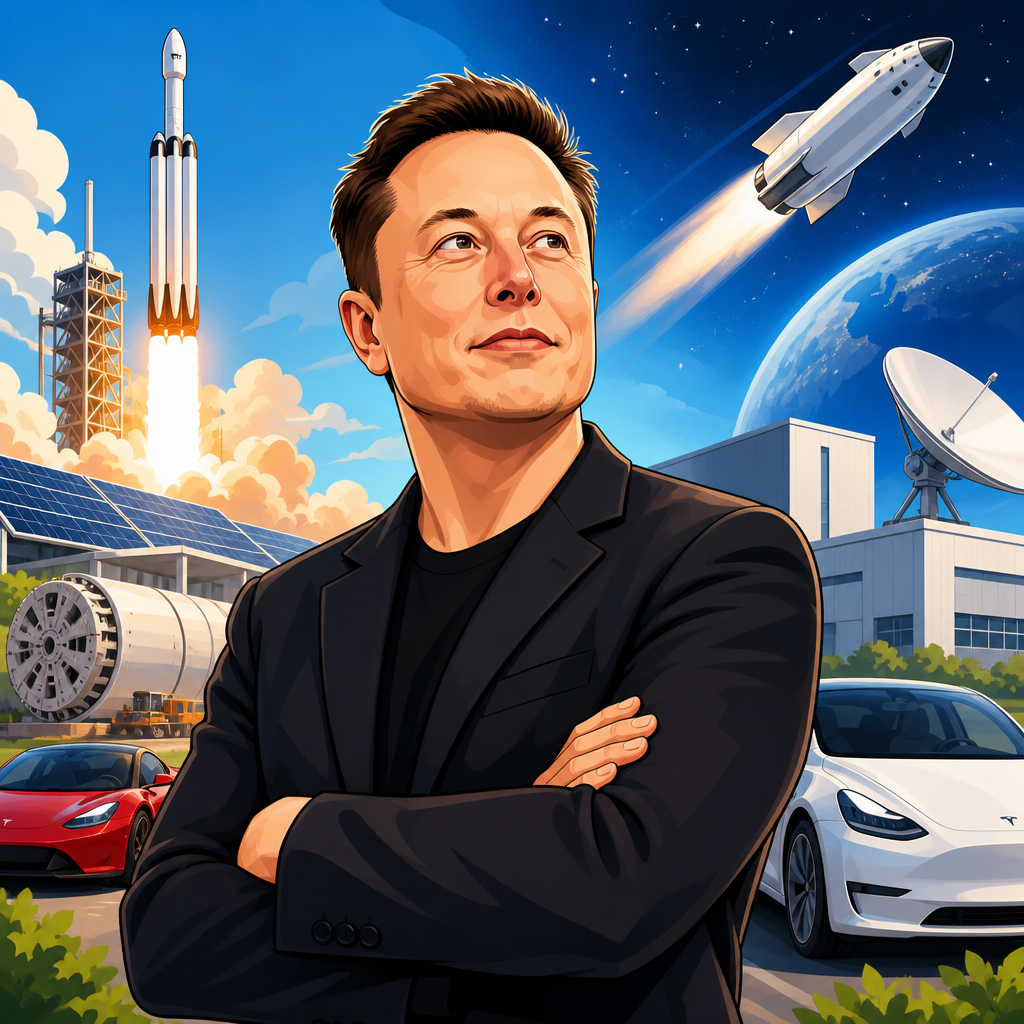
There are places in America that don’t just tell history — they make you feel it. Elon Musk’s story is not tied to one monument or highway, but it belongs in any serious study of entrepreneur success stories because it shows how technical depth, relentless execution, and unusual risk tolerance can turn ideas into multiple billion-dollar companies. For Dream Chasers building businesses, investing in founders, or teaching modern economic history, understanding how Elon Musk built multiple billion-dollar companies from scratch offers a practical framework, not just a headline. His career spans software, digital payments, electric vehicles, rockets, energy storage, and satellite internet, with each company attacking an industry most people considered too capital intensive, too regulated, or too entrenched to disrupt.
At a basic level, “from scratch” does not mean he always worked alone or funded every venture personally. It means he repeatedly entered markets early, helped define the original product direction, recruited core engineering talent, structured initial financing, and stayed close to first-principles decisions that shaped each company’s economics. “Billion-dollar company” refers either to private valuations above one billion dollars or to public market capitalizations that far exceed that threshold. By that measure, Zip2, X.com and PayPal, SpaceX, Tesla, Neuralink, The Boring Company, and xAI all qualify as major case studies in entrepreneurial value creation, though not all followed the same path or carried the same level of operational involvement from Musk.
I have spent years studying founder-led companies, and Musk stands apart for one reason above all: he did not simply identify trends; he built infrastructure around them. That distinction matters. Plenty of entrepreneurs launch apps around consumer behavior. Far fewer redesign manufacturing systems, rewrite cost curves, or vertically integrate supply chains. This hub article explains the recurring methods behind Musk’s wins, the tradeoffs behind his failures and controversies, and the lessons that connect his career to broader entrepreneur success stories. Think of it in the USDreams spirit of red, white, and blueprint: ambition paired with structure, vision disciplined by engineering, and big national-scale ideas translated into operational plans.
The first fortune: Zip2, X.com, and PayPal
Musk’s first major company, Zip2, began in 1995 when the commercial internet was still primitive. Local newspapers needed digital city guides and business directories, but most lacked the software talent to build them. Musk and his brother Kimbal created tools that helped publishers put maps, listings, and basic local content online. The timing was right. Newspapers knew the web mattered, yet they did not know how to productize it. Zip2 sold the picks and shovels rather than trying to become a media brand itself. In 1999, Compaq acquired Zip2 for roughly $307 million, giving Musk the capital and credibility to move faster in his next venture.
He then founded X.com, an online financial services and payments company. At the time, digital banking sounded risky to both consumers and regulators, but Musk understood a core internet principle: if money could move as efficiently as email, the financial layer of the web would become enormous. X.com merged with Confinity, the company behind PayPal. Internal disagreements led to leadership changes, yet the product found a decisive wedge in power sellers on eBay who needed frictionless digital payments. That is the key business lesson. Great companies often begin by solving an urgent problem for a concentrated user segment, not by serving everyone at once. When eBay bought PayPal in 2002 for $1.5 billion in stock, Musk emerged with the funds that would bankroll far more ambitious ventures.
First-principles thinking and the choice of hard industries
Most founders are advised to avoid sectors with high capital requirements, complex regulation, and slow development cycles. Musk repeatedly did the opposite. The logic came from first-principles thinking, a method borrowed from physics that breaks a problem into fundamental truths and rebuilds assumptions from there. Instead of accepting that rockets were expensive because aerospace had always been expensive, he asked what raw materials actually cost, how much margin legacy contractors layered on top, and which manufacturing choices could be redesigned. Instead of treating cars as fixed consumer products sold through traditional dealer models, he looked at battery chemistry, software integration, charging infrastructure, and direct customer relationships as variables that could be reengineered.
This matters to anyone studying entrepreneur success stories because industry selection shapes everything that follows. Musk did not chase small inefficiencies. He targeted sectors where even modest percentage improvements could create enormous enterprise value. Payments processed trillions of dollars. Automotive manufacturing influenced transportation, energy use, and software ecosystems. Launch systems determined the economics of satellites, defense, science, and communications. In each case, the opportunity was large enough to justify years of losses, operational complexity, and public skepticism. That approach is not universally right. Hard industries can destroy underprepared founders. But when a founder combines technical fluency with patient capital and a huge market, difficult sectors can become the strongest competitive moats.
SpaceX and Tesla: execution, capital, and vertical integration
SpaceX, founded in 2002, is the clearest example of Musk building where incumbents seemed unassailable. Boeing and Lockheed Martin dominated US launch markets, and spaceflight was seen as a government-adjacent field hostile to startups. SpaceX initially struggled. Its first three Falcon 1 launches failed. A fourth failure likely would have ended the company. Instead, the fourth launch succeeded in 2008, helping unlock a NASA Commercial Resupply Services contract. That contract mattered because it validated SpaceX technically and financially. From there, the company advanced to Falcon 9, Dragon, reusable boosters, and Starlink. Reusability changed the economics of launch by allowing first-stage boosters to land and fly again, compressing costs and increasing flight cadence.
Tesla followed a different path. The company was founded in 2003 by Martin Eberhard and Marc Tarpenning, and Musk joined as an early investor before later becoming chairman and then CEO. So Tesla was not literally founded from scratch by Musk alone, but his capital, product influence, fundraising, manufacturing bets, and willingness to keep the company alive during near-death periods were central to its rise. The Roadster proved electric vehicles could be desirable rather than compromised. The Model S turned that proof into a premium product. The Model 3 pursued scale. Along the way, Tesla built Gigafactories, expanded battery production, developed over-the-air software updates, and created the Supercharger network to solve range anxiety. Those were not side projects; they were system-level solutions to adoption barriers.
| Company | Launch period | Initial wedge | Key scaling move | Core lesson |
|---|---|---|---|---|
| Zip2 | 1995 | Digital tools for newspapers | B2B sales into legacy media | Sell infrastructure to urgent buyers |
| PayPal | 1999–2002 | Fast online payments for eBay users | Network effects in digital transactions | Own a painful, frequent use case |
| SpaceX | 2002 onward | Lower-cost launch services | Reusable rockets plus NASA contracts | Engineering breakthroughs can reset industry economics |
| Tesla | 2004 onward involvement | High-performance EVs | Vertical integration and charging network | Control bottlenecks that limit adoption |
The operating playbook behind multiple billion-dollar outcomes
Across these companies, several patterns repeat. First, Musk recruits elite engineers and keeps technical work close to leadership. In founder-led companies, quality of early hires determines product speed more than mission statements do. Second, he uses bold public goals to align teams, attract talent, and pressure execution. Missing timelines has often hurt credibility, but aggressive targets have also accelerated progress beyond normal corporate pacing. Third, he reinvests liquidity from one success into the next. After PayPal, he did not diversify quietly into passive wealth management. He concentrated capital into SpaceX and Tesla at levels that nearly wiped him out during the 2008 crisis.
Fourth, he favors vertical integration when supplier dependence threatens product quality, margins, or timeline control. Tesla built software, power electronics, battery systems, factories, charging infrastructure, and retail experiences that traditional automakers often outsourced or fragmented. SpaceX developed engines, avionics, structures, and launch operations in-house at unusual depth for the industry. Fifth, he markets through product spectacle and direct communication. Rocket landings, Cybertruck reveals, and social media visibility reduced customer acquisition costs in ways many companies cannot replicate. Sixth, he pursues adjacent ecosystems rather than isolated products. A Tesla is connected to batteries, solar, chargers, autonomy software, insurance, and grid services. A rocket business can support satellite deployment and broadband through Starlink.
For readers using this page as a hub for entrepreneur success stories, these are the strategic questions worth carrying into every founder case study: Did the entrepreneur enter a giant market? Did they control a critical bottleneck? Did they create proprietary technology, distribution leverage, or both? Did they survive the financing gap between invention and scale? Musk’s answers were usually yes, but not without extraordinary strain.
Limits, criticisms, and what founders should actually copy
Musk’s record is exceptional, but it should not be romanticized. His companies have faced safety investigations, labor disputes, production setbacks, regulatory scrutiny, and governance criticism. Tesla’s “production hell” during the Model 3 ramp showed how scaling manufacturing differs from building prototypes. SpaceX successes came after repeated failures and very real chances of collapse. Social media attention has amplified both his brand power and his controversy. Founders who copy only the bravado usually fail because they import the noise without the engineering rigor, capital strategy, or work intensity that supported it.
The durable lessons are more grounded. Start with a mission large enough to justify years of difficulty. Learn the physics, economics, and constraints of your industry better than competitors. Build for a specific beachhead market first, then expand. Raise enough capital for the real journey, not the optimistic deck version. Control the bottlenecks that would otherwise leave your fate in suppliers’ hands. And understand the personal cost. Musk’s path required extreme concentration, public pressure, and a tolerance for operational chaos that most people neither want nor should seek. Even so, his story remains a defining case in modern entrepreneurship, one worth revisiting whether you are planning your next venture, teaching a classroom, or mapping a Success Stories & Case Studies reading path for The Great American Rewind. Pour a cup from Old Glory Coffee Roasters, keep Franklin the eagle in mind, explore the connected founder profiles across USDreams, and apply the parts of this blueprint that fit your own road ahead. Until next time, Dream Chasers — keep chasing. 🇺🇸
Frequently Asked Questions
How did Elon Musk build multiple billion-dollar companies from scratch?
Elon Musk built multiple billion-dollar companies by combining deep technical understanding, a clear view of where markets were heading, and an unusually high tolerance for risk. Instead of chasing small opportunities, he consistently targeted large industries that were overdue for change, including finance, transportation, space, and energy. Early in his career, he co-founded Zip2 to help newspapers adapt to the internet, then used the proceeds from that success to help build X.com, which evolved into PayPal. Rather than protecting his wealth after those wins, he reinvested heavily into new ventures with far greater complexity and uncertainty.
What separates Musk from many entrepreneurs is that he did not simply fund ideas from a distance. He immersed himself in engineering, product design, manufacturing, and operations. At SpaceX, he pushed for vertically integrated aerospace production to lower launch costs. At Tesla, he helped drive product strategy, battery innovation, software integration, and manufacturing scale. In both cases, the companies entered industries dominated by larger, more established players, yet won by improving product performance, cost structure, and long-term vision. His success was not built on one lucky breakthrough. It came from repeatedly identifying broken systems, assembling strong teams, demanding rapid iteration, and staying committed long enough to outlast skepticism.
What role did risk-taking play in Elon Musk’s success?
Risk-taking was central to Elon Musk’s rise, but it was not random or reckless in the casual sense people often imagine. His approach involved making bold bets when he believed the underlying logic was strong, even if the odds of short-term success looked poor. After PayPal was sold, he could have comfortably stepped away. Instead, he put much of his personal fortune into SpaceX, Tesla, and SolarCity at a time when each company faced serious doubts. Space exploration was considered too capital-intensive for a startup, electric cars were widely viewed as niche products, and clean energy businesses were often dismissed as financially unstable.
The defining moment came during the late 2000s, when both Tesla and SpaceX were under intense pressure and running low on cash. Musk reportedly committed nearly everything he had left to keep them alive. That period illustrates an important lesson for Dream Chasers and founders: exceptional outcomes often require enduring periods where failure seems more likely than success. However, the real takeaway is not merely “take big risks.” It is to take informed risks in markets where a major breakthrough would create lasting competitive advantage. Musk’s willingness to commit capital, reputation, and years of effort gave his companies the runway they needed to survive long enough for their business models to prove themselves.
Why is technical depth considered such an important part of Elon Musk’s business strategy?
Technical depth is one of the most important reasons Elon Musk was able to build companies in difficult industries where many others would have failed. He is not just a promoter or capital allocator. He is known for diving into first principles, questioning assumptions, and understanding engineering constraints at a detailed level. That matters because in sectors like rockets, electric vehicles, batteries, and energy systems, you cannot build a category-defining company through branding alone. You need to solve hard technical problems, reduce costs, improve performance, and make products better than legacy alternatives.
This first-principles approach allowed Musk and his teams to rethink what others accepted as fixed. At SpaceX, one of the central questions was why rockets cost so much. Instead of accepting traditional aerospace pricing, the company focused on designing and building more components in-house and eventually made reusable rockets commercially viable. At Tesla, the company did not just market electric vehicles as environmentally friendly; it built cars that were fast, technologically advanced, and desirable. For entrepreneurs, the broader lesson is powerful: if you truly understand the mechanics of your industry, you are better positioned to challenge incumbents, spot inefficiencies, and create products competitors struggle to match.
What can entrepreneurs and investors learn from Elon Musk’s company-building approach?
Entrepreneurs can learn that transformational companies often begin with a willingness to pursue difficult problems that others avoid. Musk did not build his career by choosing easy, low-competition markets. He went after sectors with enormous scale and clear dysfunction. That strategy made the path harder, but it also made the upside far greater. Founders studying his journey should notice the combination of long-term vision and short-term execution. Musk consistently communicates sweeping missions, such as accelerating sustainable energy or making life multiplanetary, but those missions are backed by highly specific product and operational milestones.
Investors can learn a different but equally important lesson: some of the most valuable companies look unreasonable in their early stages. Conventional analysis often underestimates founders who combine ambition, technical credibility, and execution intensity. Musk’s track record shows that founder quality can be a decisive variable when a company is attempting something structurally difficult. That said, his story also highlights how rare this type of success is. Not every bold founder is the next Elon Musk. The practical takeaway for investors is to look for evidence of deep market insight, unusual resilience, product obsession, and the ability to attract top talent. For entrepreneurs and teachers of modern economic history alike, Musk’s career demonstrates how individual leadership can reshape entire industries when paired with timing, capital, and operational discipline.
Did Elon Musk succeed because of vision alone, or were timing and execution just as important?
Elon Musk’s success was never about vision alone. Vision gave direction, but timing and execution turned that direction into real companies with durable value. Many people can imagine a better future. Far fewer can build the systems needed to reach it. Musk entered several markets at moments when enabling technologies were becoming viable. Internet adoption helped create the conditions for Zip2 and PayPal. Improvements in battery technology, software, and consumer demand made Tesla’s growth possible. Advances in computing, materials, and manufacturing helped SpaceX pursue lower-cost launches and reusable rockets. In other words, Musk was not operating outside of history; he was recognizing inflection points before most people fully appreciated them.
Execution was the force multiplier. Building a company worth billions requires hiring elite talent, surviving cash shortages, managing production setbacks, refining products, raising capital, and persuading customers to trust something new. Musk’s companies faced delays, criticism, and near-failure repeatedly. What made the difference was the ability to keep moving, adapt under pressure, and improve products until the market responded. For readers studying entrepreneur success stories, this is one of the clearest lessons from Elon Musk’s career: vision matters, but execution decides outcomes. The entrepreneurs who build lasting companies are usually the ones who can pair a bold future narrative with relentless day-to-day problem solving.