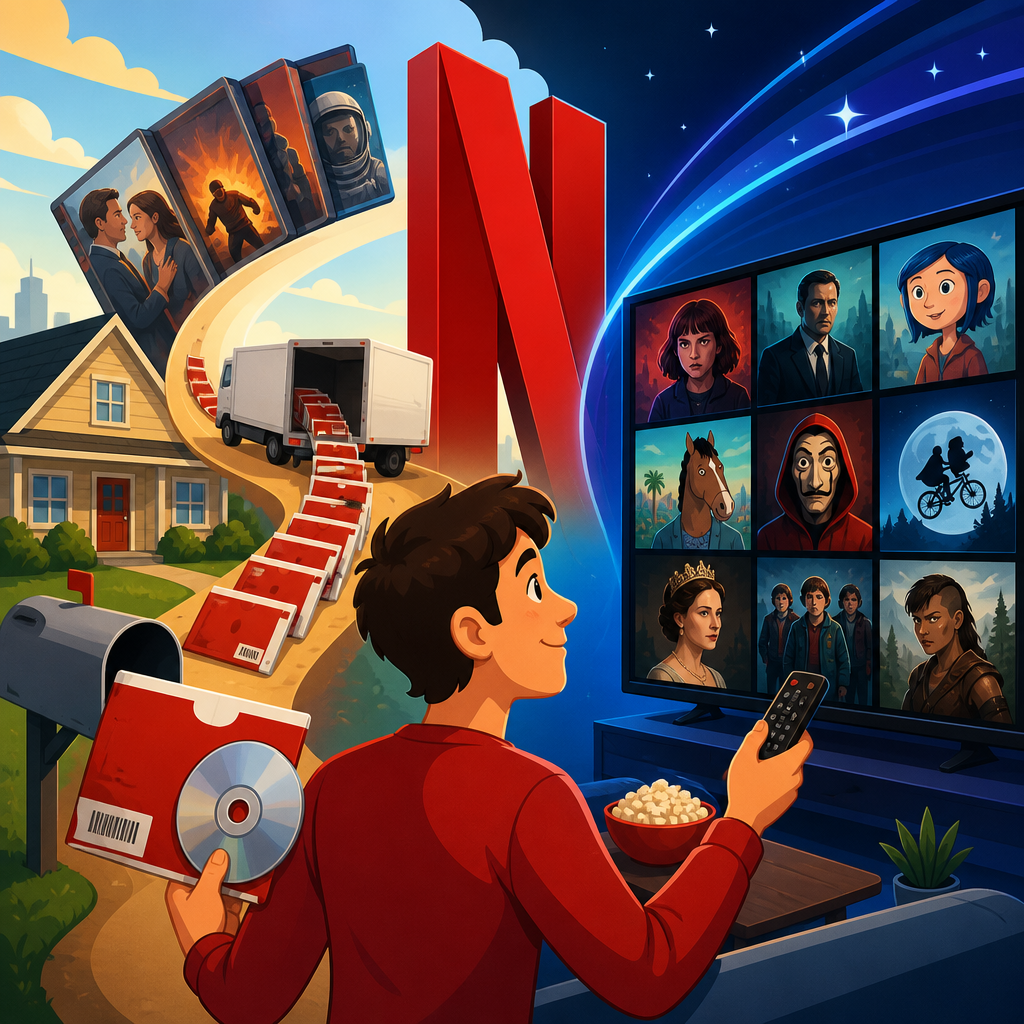
There are places in America that don’t just tell history — they make you feel it. Netflix may not be a battlefield, monument, or winding interstate landmark, but its rise belongs in any serious conversation about modern American ingenuity. The story behind Netflix, from DVDs to streaming giant, is fundamentally an entrepreneur success story: a case study in spotting a market gap, building a better system, surviving disruption, and then causing disruption again. For Dream Chasers who study how companies actually scale, Netflix offers more than corporate trivia. It shows how timing, business model design, culture, technology, and leadership decisions can turn a practical service into a global habit.
When people ask what Netflix is, the short answer is simple: Netflix is a media company that began in 1997 as a DVD-by-mail rental business and evolved into one of the world’s dominant streaming and entertainment platforms. The longer answer matters more. Netflix was founded by Reed Hastings and Marc Randolph in California during the dot-com era. It first solved a clear consumer frustration: renting movies without late fees or inconvenient store trips. Over time, it used subscription pricing, recommendation software, original programming, cloud infrastructure, and international expansion to outmaneuver older competitors, especially Blockbuster. In business terms, Netflix is a classic example of product-market fit followed by deliberate reinvention.
This matters because entrepreneur success stories are often oversimplified into luck, charisma, or one brilliant idea. In practice, the winning pattern is usually red, white, and blueprint: identify pain points, test assumptions, build systems, and adapt faster than incumbents. I have worked through enough case studies and operating models to say with confidence that Netflix is one of the cleanest examples of strategic evolution in the digital era. Its journey helps founders, marketers, investors, teachers, and students understand subscription economics, customer retention, platform strategy, and the risks of standing still when technology changes.
How Netflix Started and Why the DVD Model Worked
Netflix launched in 1997, at a time when home entertainment was dominated by physical stores. Blockbuster had thousands of locations, strong brand recognition, and a business model built around nightly rentals and late fees. Netflix took a different path. DVDs were lighter, more durable, and easier to ship than VHS tapes, which made mail delivery feasible. The company introduced an online catalog where customers selected titles, then received discs by mail with prepaid return envelopes. This removed the most disliked part of video rental: driving to a store only to find popular titles unavailable.
The subscription model became the real breakthrough. Instead of charging per rental, Netflix offered a monthly plan with no due dates and no late fees. That changed customer psychology immediately. Consumers no longer felt penalized for keeping a movie an extra day, and Netflix gained predictable recurring revenue. In operational terms, recurring subscriptions improved forecasting, inventory planning, and customer lifetime value. The company also built regional distribution centers to reduce turnaround time. Faster delivery improved satisfaction and reduced churn, which is the percentage of subscribers who cancel.
Another early advantage was data. Because customers built queues online, Netflix could track preferences and demand patterns more accurately than a typical store manager eyeballing shelf turnover. That information helped with inventory allocation and, later, recommendation systems. The lesson for entrepreneur success stories is straightforward: a company often wins first by solving a boring operational problem better than everyone else. Convenience is not glamorous, but it is powerful.
How Netflix Beat Blockbuster
Netflix did not defeat Blockbuster overnight. For years, Blockbuster remained vastly larger, with more resources and store traffic. What changed was that Netflix aligned its business model with consumer behavior while Blockbuster stayed tied to legacy economics. Blockbuster depended heavily on late fees, which reportedly generated hundreds of millions in annual revenue before the company eliminated them. Netflix built its entire brand around removing that friction. Consumers understood the difference instantly.
There is also a famous strategic moment: Netflix reportedly approached Blockbuster around 2000 with an acquisition discussion valued near $50 million, and Blockbuster declined. Whether remembered as dismissal or miscalculation, the episode captures a larger truth. Incumbents often underestimate challengers that begin in a niche. Netflix looked small because DVDs by mail looked small. But the model created direct customer relationships, valuable data, and a subscription engine that could later support streaming.
| Factor | Netflix | Blockbuster |
|---|---|---|
| Core model | Online subscription with mailed DVDs | Retail store rentals |
| Customer pain point | Removed late fees and store trips | Relied on in-person visits and stock availability |
| Revenue structure | Recurring monthly subscriptions | Transaction rentals and late fees |
| Data capability | Tracked queues, ratings, and behavior digitally | Less centralized customer preference data |
| Adaptability | Built for online evolution | Constrained by retail footprint |
Blockbuster eventually attempted its own mail service and later digital offerings, but timing and organizational inertia worked against it. Netflix had already built customer trust and operational competence. This is one of the clearest answers to a common search question: Why did Netflix succeed while Blockbuster failed? Because Netflix optimized for where behavior was going, not where revenue had been.
The Shift From DVDs to Streaming
Netflix introduced streaming in 2007, and that decision changed the company’s trajectory from clever rental service to category-defining media platform. Broadband internet was improving, connected devices were becoming more common, and viewers increasingly expected on-demand access. Streaming eliminated shipping costs, postage, and physical inventory constraints. It also allowed instant gratification, which is often the difference between a useful service and a daily habit.
The transition was not risk free. At that stage, the DVD business still generated meaningful cash. Moving customers toward streaming required licensing digital content, investing in software, and preparing for new competitors. It also meant managing two models at once. I have seen many companies fail here: they either protect the old cash cow too long or abandon it before the replacement is ready. Netflix handled the shift aggressively, though not perfectly. Its 2011 attempt to separate DVD and streaming under the Qwikster brand drew a sharp backlash and was quickly reversed. Even so, the deeper strategic direction was correct.
Streaming also changed the economics of scale. Once the platform was built, adding another subscriber did not require mailing another disc. Marginal distribution costs fell dramatically relative to physical rental. That gave Netflix room to grow faster, expand device partnerships, and integrate into televisions, game consoles, tablets, and smartphones. Convenience became nearly frictionless.
Technology, Personalization, and the Netflix Experience
Netflix is not just a content company; it is a technology company with an entertainment product. One reason it retained viewers so effectively was personalization. Its recommendation engine used viewing history, ratings, and behavior patterns to suggest titles likely to keep subscribers engaged. The company’s well-known recommendation competition, the Netflix Prize, highlighted how seriously it treated algorithmic improvement. Better recommendations increase watch time, reduce decision fatigue, and make a large catalog feel more useful.
Infrastructure mattered too. Netflix became a leading example of cloud-based scaling after migrating much of its operations to Amazon Web Services following major outages in its earlier architecture. That move improved resilience and allowed global delivery at massive scale. On the engineering side, Netflix popularized ideas such as chaos engineering through tools like Chaos Monkey, intentionally testing system failures to strengthen reliability. In plain terms, Netflix prepared for things to break before customers noticed them breaking.
These choices shaped user expectations across the industry. Fast startup times, personalized homepages, autoplay previews, cross-device continuity, and adaptive streaming quality became standard features partly because Netflix trained customers to expect them. In entrepreneur success stories, superior user experience often looks effortless from the outside because the hard systems work stays invisible.
Why Original Content Changed Everything
Licensing movies and television shows helped Netflix grow, but licensed libraries come with expiration dates, rising costs, and dependence on studios that may become competitors. Original content changed that power balance. In 2013, House of Cards signaled that Netflix intended to compete not just in distribution but in programming. Orange Is the New Black, Stranger Things, The Crown, and later global hits such as Squid Game proved the model could work across genres and markets.
Original content gave Netflix several strategic benefits. First, exclusivity reduced churn because subscribers could not watch flagship shows elsewhere. Second, intellectual property created long-term asset value instead of temporary access. Third, data-informed commissioning improved decision-making. Netflix could examine genre demand, completion rates, actor appeal, and regional preferences before backing projects. Data did not replace creative judgment, but it sharpened it.
There are tradeoffs here. Original production is expensive, risky, and operationally complex. A streaming catalog packed with originals can still disappoint if quality becomes inconsistent. Yet the overall strategy was decisive. Netflix stopped being merely the delivery pipe and became a studio with global reach.
Lessons for Entrepreneurs From the Netflix Story
The story behind Netflix offers practical lessons for anyone building a company. Start with a painful customer problem, not a flashy technology. Use pricing to remove friction and encourage retention. Build data loops early so each transaction improves the product. Be willing to disrupt your own successful model before someone else does it for you. Invest in infrastructure before scale exposes weaknesses. Finally, understand that brand trust is earned through repeated convenience, not slogans.
For a sub-pillar hub on entrepreneur success stories, Netflix belongs alongside other landmark business case studies because it combines invention, discipline, and reinvention. Readers exploring related stories should compare it with Amazon on customer obsession, Apple on ecosystem control, and Airbnb on marketplace behavior. The shared pattern is not magic. It is strategic consistency under changing conditions. That is why teachers use Netflix in classrooms, founders reference it in pitch decks, and operators study it when thinking about subscriptions, content, and digital transformation.
Netflix became a streaming giant because it kept solving the next problem before the previous solution stopped working. It began with DVDs, won with subscriptions, scaled through technology, and strengthened its position with original content and global expansion. The biggest takeaway is clear: entrepreneurial success rarely comes from one idea. It comes from building an organization that can evolve. If you are mapping your own business journey, study Netflix closely, then explore the rest of our entrepreneur success stories hub with the same spirit that fuels The Great American Rewind, a cup of Old Glory Coffee Roasters, and the steady confidence of Franklin circling overhead. Until next time, Dream Chasers — keep chasing. 🇺🇸
Frequently Asked Questions
How did Netflix begin, and what problem was it trying to solve?
Netflix began in 1997, founded by Reed Hastings and Marc Randolph at a time when home entertainment was dominated by brick-and-mortar rental chains, especially Blockbuster. The core problem they saw was simple but powerful: renting movies was inconvenient, expensive, and frustrating for customers. People had to drive to a store, hope the title they wanted was in stock, return it on time, and often pay costly late fees if life got in the way. Netflix recognized that this entire experience was built around the needs of the retailer, not the consumer.
The company’s early insight was that DVDs, which were lighter and more durable than VHS tapes, could be mailed efficiently. That opened the door to a completely different business model. Instead of making customers come to the store, Netflix could send movies directly to their homes. This was more than a new delivery method; it was a rethinking of the rental experience itself. By reducing friction and eliminating a major customer pain point, Netflix positioned itself as a service built around convenience, flexibility, and user satisfaction.
What makes this especially important in the broader story of American entrepreneurship is that Netflix did not invent movies, DVDs, or even home entertainment. Its breakthrough was seeing a market gap others had normalized. That is often how major business success stories begin: not with creating something from nothing, but with identifying a broken system and designing a better one. In that sense, Netflix is a textbook example of entrepreneurial problem-solving at work.
Why was Netflix’s DVD-by-mail model such a game changer?
Netflix’s DVD-by-mail model changed the industry because it removed several pain points that customers had long accepted as unavoidable. Traditional video rental stores operated on limited shelf space, local inventory, store hours, and a penalty-based system centered on late fees. Netflix replaced that with a broader catalog, home delivery, and eventually a subscription structure that let users keep discs without worrying about due dates in the old sense. That was a dramatic shift in the relationship between company and customer.
One of the smartest elements of the model was the subscription approach. Rather than relying primarily on one-time rental transactions, Netflix encouraged recurring membership, which gave the company more predictable revenue and gave users a sense of freedom. Customers could create queues, receive DVDs by mail, watch on their own schedule, and send them back when ready. It felt more personalized, more convenient, and less punitive than the traditional rental-store experience.
Just as important, Netflix used data early and effectively. The company paid close attention to viewing patterns, customer ratings, and rental behavior, which helped it improve recommendations and guide users toward titles they were more likely to enjoy. This made the service feel smarter over time. So the game-changing nature of the DVD-by-mail model was not just logistical. It combined convenience, subscription economics, and data-driven personalization into a system that made the old model seem increasingly outdated. For entrepreneurs, it is a strong reminder that innovation often comes from redesigning the customer journey from end to end.
How did Netflix survive the shift from DVDs to streaming when so many companies struggle with disruption?
Netflix survived because it was willing to disrupt itself before someone else could do it. That is one of the most important lessons in the company’s rise. The DVD-by-mail business was successful, recognizable, and profitable, but Netflix leadership understood that technology was changing consumer behavior. As internet speeds improved and digital delivery became more realistic, the company saw that the future of entertainment would not depend on physical discs forever. Instead of clinging to the business model that made it successful, Netflix invested in the model that could eventually replace it.
This transition was not simple or risk-free. Streaming in its early days had technical limitations, licensing complications, and uncertain economics. Netflix had to build the infrastructure, negotiate content rights, and convince consumers to embrace a new way of watching. At the same time, it had to manage a legacy DVD business that still mattered. Many companies fail in moments like this because they try to protect the past too aggressively. Netflix moved forward even when the path was imperfect, and that willingness to evolve gave it a head start.
The larger reason Netflix made the leap successfully is that it was guided by long-term thinking. It did not treat streaming as a side experiment; it treated it as the future. That strategic clarity helped the company make bold decisions, even unpopular ones, in pursuit of a larger transformation. For Dream Chasers and aspiring founders, this is one of the clearest takeaways from the story behind Netflix: lasting success is not just about building a winning model, but recognizing when that winning model has an expiration date.
What role did original content play in turning Netflix into a streaming giant?
Original content played a decisive role in Netflix’s transformation from distributor to entertainment powerhouse. In the beginning, Netflix relied heavily on licensed movies and television shows from major studios and networks. That helped attract subscribers, but it also created vulnerability. Licensed content can be expensive, temporary, and controlled by outside companies that may later decide to launch competing platforms. Netflix understood that if it wanted long-term strength, it needed to own more of what made its service valuable.
That realization led to one of the most important strategic pivots in modern media. By investing in original programming, Netflix gained greater control over its catalog, brand identity, and customer loyalty. Shows like House of Cards, Orange Is the New Black, and later global hits across multiple genres proved that Netflix was not just a place to watch content; it was a place where must-watch content originated. This elevated the company from a convenience platform to a cultural force.
Original content also reinforced the company’s data-informed strategy. Netflix could analyze viewing habits to understand what audiences were watching, when they were watching, and what kinds of stories retained attention. While creativity can never be reduced entirely to algorithms, Netflix used data to support content investment decisions in ways that traditional media companies had not done at the same scale. The result was a library that helped define the streaming era. In practical terms, original programming gave Netflix differentiation, bargaining power, and a stronger competitive moat, all of which were crucial in its rise to global dominance.
What entrepreneurial lessons can readers take from the story behind Netflix?
The story behind Netflix offers several enduring entrepreneurial lessons. First, it shows the power of identifying a frustrating but widely accepted customer problem. Before Netflix, late fees, limited inventory, and inconvenient store visits were considered normal. Netflix succeeded by questioning that normal. Great businesses often begin when someone notices an everyday pain point and refuses to treat it as inevitable.
Second, Netflix demonstrates the importance of business model innovation. The company did not simply sell a better product; it created a better system for access, payment, and discovery. Its subscription model, recommendation engine, and later streaming platform all reflected a larger truth: sometimes the breakthrough is not the product itself, but the structure around it. Entrepreneurs who understand this are often better positioned to build durable advantages.
Third, Netflix is a masterclass in adaptation. Many companies can launch well, but far fewer can evolve across multiple technological eras. Netflix moved from mailed DVDs to streaming, then from licensed content to original productions, and then into global expansion. Each stage required different capabilities, different risks, and different strategic thinking. That ability to keep changing without losing momentum is rare and deeply instructive.
Finally, Netflix teaches that disruption is not a one-time event. The company first disrupted traditional rental stores, then had to disrupt its own successful model to stay relevant. That is a critical lesson for Dream Chasers, founders, and anyone studying entrepreneur success stories. Winning once is not enough. The real challenge is building a mindset that stays curious, restless, and ready for the next shift before the market forces it on you.