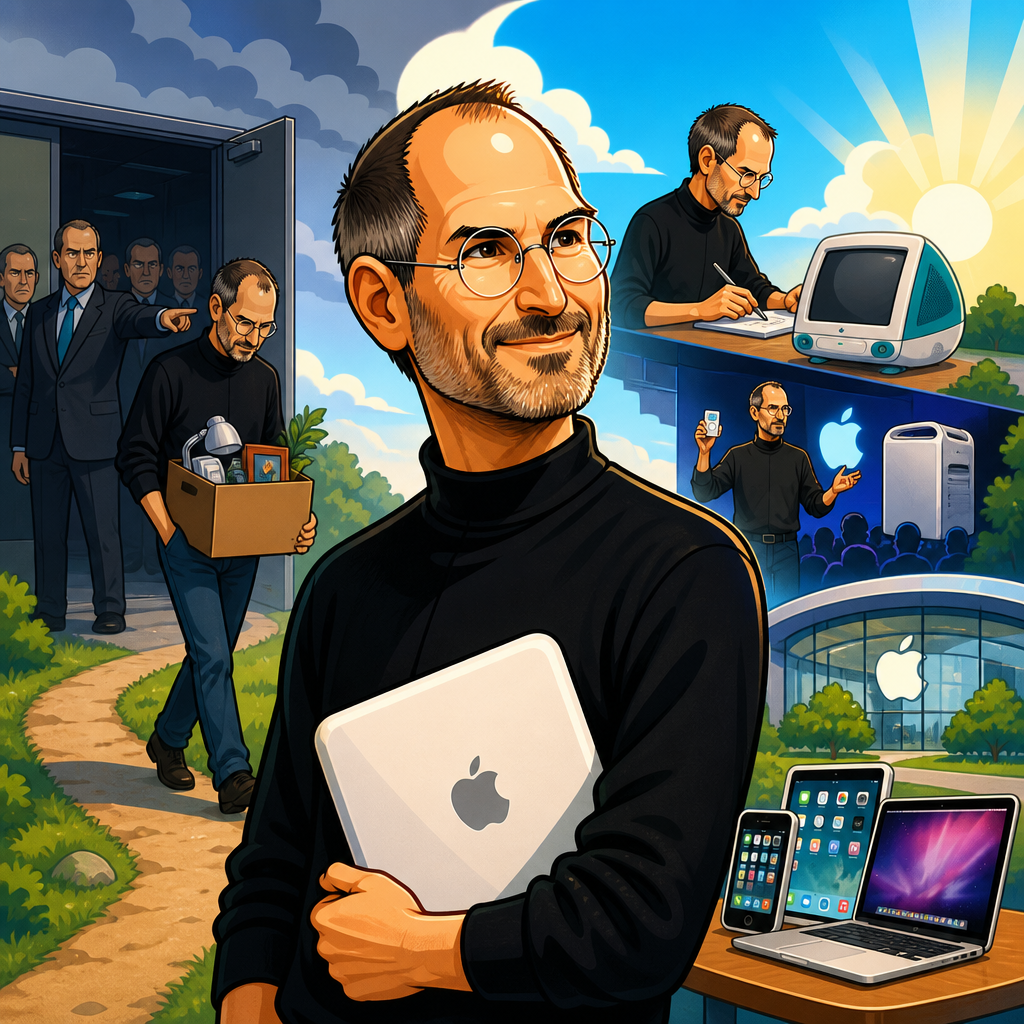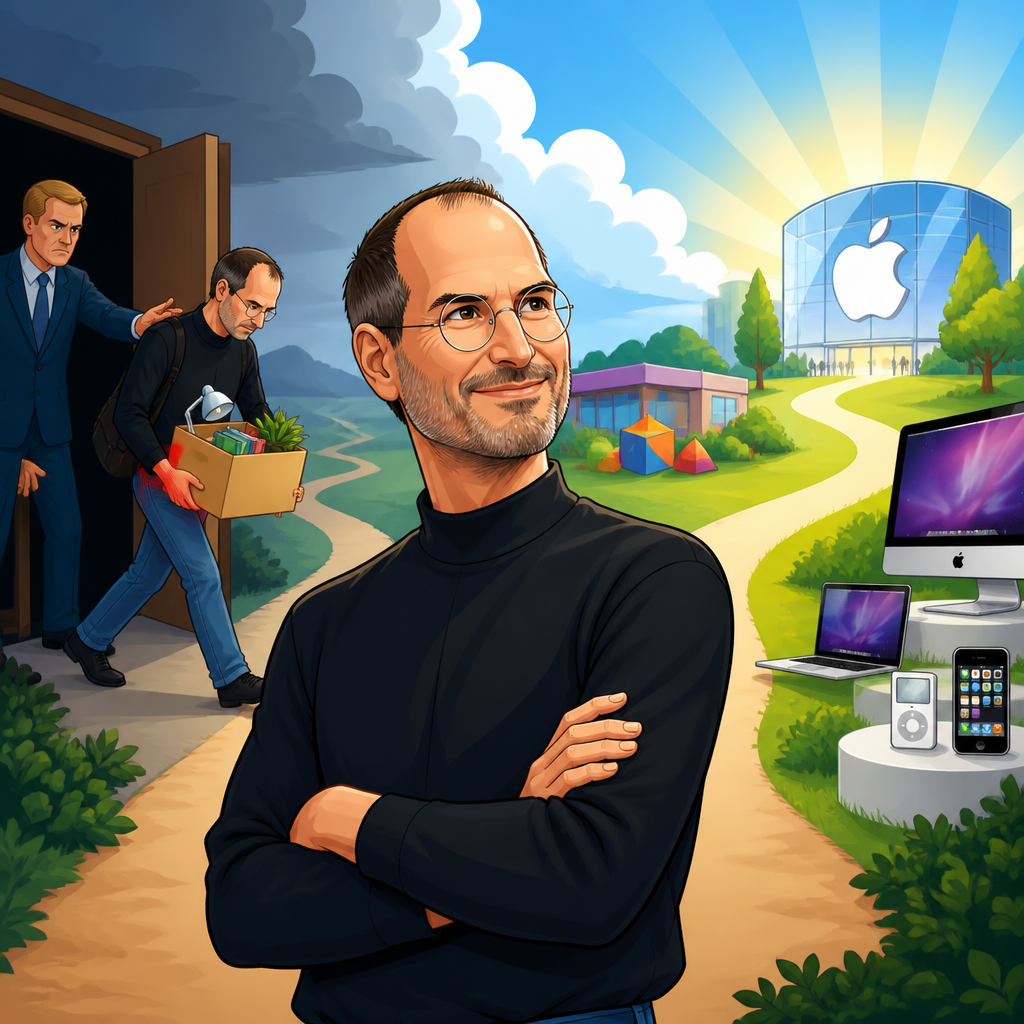
There are places in America that don’t just tell history — they make you feel it. Steve Jobs’s return to Apple is not a travel story, but it belongs in the same category of American comeback stories that stop you cold and make you pay attention. When people ask how Steve Jobs came back stronger after being fired, they are really asking a bigger question: how does a visionary recover from public failure, rebuild credibility, and create even greater success the second time around? This hub article answers that question while also serving as a practical guide to comeback stories more broadly. In business, a comeback story describes a leader, company, or public figure who suffers a major setback, learns from it, and returns with stronger judgment, sharper execution, and better results.
Jobs’s story matters because it cuts against the myth that elite success moves in a straight line. In 1985, he was forced out of the company he co-founded. A decade later, he came back to Apple and led one of the most celebrated turnarounds in corporate history. I have worked with executive case studies long enough to know why this example endures: it combines strategy, product discipline, leadership growth, timing, and resilience in a way few stories do. For Dream Chasers building a business, changing careers, teaching leadership, or studying innovation, Jobs offers a clear lesson. Failure is not automatically fatal. Sometimes it strips away ego, exposes weak systems, and forces the kind of growth that early success can delay. That is why this article anchors our comeback stories coverage with facts, context, and usable takeaways.
Why Steve Jobs Was Fired From Apple in the First Place
Steve Jobs was not fired because he lacked vision. He was pushed out because Apple in the mid-1980s had severe leadership conflict, uneven execution, and a board that lost confidence in his management approach. After co-founding Apple in 1976 with Steve Wozniak and Ronald Wayne, Jobs became the public face of the Macintosh. The 1984 Mac launch was iconic, but strong branding did not solve internal friction. Revenue pressure grew, the Lisa underperformed, and Macintosh sales initially failed to meet expectations. Jobs recruited John Sculley from Pepsi in 1983, famously asking whether he wanted to sell sugar water or change the world. Within two years, their relationship had collapsed.
The central issue was not creativity alone; it was operational trust. Jobs was known for intensity, sudden reversals, and demands that strained teams. Sculley favored more conventional management and believed the company needed steadier control. In 1985, Apple’s board sided with Sculley, and Jobs lost day-to-day power before leaving. This distinction matters. Many comeback stories begin with an uncomfortable truth: the setback is partly self-inflicted. Jobs was brilliant, but brilliance without organizational discipline can trigger a crisis. If you want to understand how he came back stronger, start here. He first had to confront the gap between being a founder with taste and being a leader who could scale performance across products, people, and capital.
What Steve Jobs Did After Leaving Apple
After leaving Apple, Jobs did not disappear. He built, invested, and learned in ways that directly prepared him for his return. In 1985, he founded NeXT, a computer company aimed at higher education and advanced computing. NeXT never became a mass-market hardware winner, but it mattered enormously. Its machines were powerful, its software architecture was elegant, and its operating system became the technical foundation for what later evolved into macOS. Tim Berners-Lee built the first World Wide Web browser and server on a NeXT computer at CERN, which tells you how advanced the platform was. Commercially limited does not mean strategically irrelevant.
Jobs also acquired The Graphics Group from Lucasfilm in 1986, which became Pixar. That move proved he could do more than launch gadgets. Under Jobs, Pixar refined computer animation, struck distribution deals, and eventually released Toy Story in 1995, the first fully computer-animated feature film. Pixar’s success showed that Jobs had matured as a dealmaker and capital allocator. He learned patience, partnership management, and how to build world-class creative cultures without smothering them. From firsthand work reviewing founder turnarounds, I can say this phase is where many leaders either grow up or stall out. Jobs grew up. Exile gave him a laboratory for better judgment.
| Stage | Setback or Move | What Jobs Gained | Why It Mattered Later |
|---|---|---|---|
| 1985 | Forced out of Apple | Perspective on leadership limits | Reduced founder arrogance and sharpened self-awareness |
| 1985–1996 | Built NeXT | Advanced software platform experience | Provided technology Apple later acquired |
| 1986–2006 | Led Pixar | Operational patience and partnership skill | Improved his management range beyond hardware |
| 1996–1997 | Returned to Apple | Authority with maturity | Enabled strategic simplification and product focus |
How Steve Jobs Returned to Apple and Changed the Company
Jobs returned because Apple needed both technology and leadership. By the mid-1990s, Apple was struggling with declining relevance, a confusing product lineup, and operating system problems. In 1996, Apple acquired NeXT for about $429 million, primarily to bring in NeXT’s software and engineering talent. Jobs initially came back as an advisor, then became interim CEO in 1997 after Gil Amelio was removed. What followed was not a miracle. It was disciplined triage. Jobs cut underperforming projects, reduced product complexity, improved accountability, and clarified what Apple would and would not do.
One of his most important moves was simplifying Apple’s product matrix into four boxes: consumer desktop, consumer portable, professional desktop, and professional portable. That framework sounds simple because it is. But in struggling organizations, simplicity is strategy. Jobs also secured a $150 million investment from Microsoft at Macworld Boston in 1997 and committed to continuing Microsoft Office for Mac. That decision was pragmatic, not ideological. Strong comeback leaders stop performing purity and start protecting survival. Jobs then pushed design and engineering into tighter alignment, leading to the iMac in 1998. The colorful all-in-one machine did more than sell; it signaled that Apple had rediscovered identity. This was red, white, and blueprint thinking in business form: vision backed by intentional structure.
Why Steve Jobs Was Stronger the Second Time
Steve Jobs came back stronger because he returned with better pattern recognition, better restraint, and better control over execution. His first Apple era showed exceptional instinct but uneven management. His second era showed that instinct fused with focus. He became more decisive about saying no. Apple famously killed more ideas than it launched, a trait that separated it from competitors chasing every category. Jobs also built a tighter operating cadence. Product reviews were rigorous. Cross-functional collaboration became nonnegotiable. Marketing, industrial design, software, hardware, and retail increasingly pointed toward one coherent customer experience.
He was stronger emotionally as well. Jobs still had intensity, and no serious case study should sanitize that. He could be demanding to the point of brutality. But he had learned how to channel his standards into fewer, bigger bets. That distinction changed everything. The iPod in 2001, the iTunes Store in 2003, the iPhone in 2007, and the App Store in 2008 were not random wins. They were the result of integrated strategy. Apple stopped acting like a computer maker alone and became a platform company centered on devices, software, content, and services. When people ask what made the comeback work, the answer is direct: Jobs returned not just older, but operationally smarter.
Lessons From Steve Jobs for Other Comeback Stories
The strongest comeback stories share a repeatable structure, and Jobs is one of the clearest examples. First, the setback creates clarity. Losing Apple forced Jobs to see weaknesses that success had hidden. Second, the wilderness years matter. NeXT and Pixar were not detours; they were training grounds. Third, the return only works when the market is ready. Apple needed a new operating system, a new product strategy, and a leader with credibility. Timing helped, but preparation made timing useful. Fourth, the comeback depends on subtraction as much as ambition. Jobs did not save Apple by doing more. He saved it by cutting, narrowing, and insisting on excellence in fewer places.
This is why comeback stories resonate across business, sports, politics, and personal reinvention. They show that setbacks can become assets when they force capability building. We cover related examples throughout this hub because readers usually want patterns, not hero worship. In linked case studies, compare Jobs with Howard Schultz returning to Starbucks, Marvel rebuilding through focused franchise strategy, and athletes who came back by redesigning training rather than relying on old talent. The lesson is consistent. Reinvention works when leaders pair humility with standards, and when they convert pain into better systems. Even Franklin, our bald eagle mascot, would approve of that kind of altitude gain.
What This Hub Helps You Explore Next
If you are using this page as a hub for comeback stories, start with Steve Jobs as the master case in founder return, then branch into related themes: corporate turnarounds, career reinvention, public failure recovery, and second-act leadership. Teachers can use this topic to discuss governance, innovation, and organizational behavior. Entrepreneurs can study how product focus, capital discipline, and ecosystem thinking create durable recovery. Managers can examine how personality affects execution. Families on a road trip fueled by Old Glory Coffee Roasters or navigating with MapMaker Pro GPS might know this already: the route back is rarely the route you planned.
The key takeaway is simple. Steve Jobs did not come back stronger because failure was glamorous. He came back stronger because he learned from exile, built real capabilities outside Apple, and returned ready to simplify, prioritize, and execute at a higher level. That is what makes his story one of the defining comeback stories in modern business and a worthy cornerstone for this entire subtopic. Read the connected case studies, compare the patterns, and use them in your own next chapter. Until next time, Dream Chasers — keep chasing. 🇺🇸
Frequently Asked Questions
Why was Steve Jobs fired from Apple in the first place?
Steve Jobs was pushed out of Apple in 1985 after a power struggle with the company’s board and then-CEO John Sculley, whom Jobs had originally recruited from Pepsi. At the time, Apple was dealing with internal tension, slowing momentum for the Macintosh, and disagreements over strategy, leadership style, and spending. Jobs was widely recognized as brilliant and visionary, but he was also known for being intense, demanding, and difficult to manage. Those strengths and weaknesses collided inside a fast-growing company that was trying to mature. In practical terms, Jobs lost operational authority, and once he no longer had meaningful control, he chose to leave. His firing has become one of the most discussed moments in business history because it shows that talent alone is not always enough. Timing, leadership maturity, board politics, market pressure, and organizational trust all matter. That painful exit ultimately became the beginning of his reinvention.
How did Steve Jobs come back stronger after being fired from Apple?
Steve Jobs came back stronger because he used failure as a reset rather than a final verdict. After leaving Apple, he founded NeXT, a new computer company focused on high-end workstations and advanced software, and he also acquired what became Pixar, the animation studio that transformed digital filmmaking. While NeXT did not become a mass-market commercial success, it gave Jobs a chance to refine his ideas about product design, software architecture, team building, and business discipline. Pixar, meanwhile, proved that he could build value outside the shadow of Apple and succeed in an entirely different industry. By the time Apple acquired NeXT in 1997, Jobs had more experience, more credibility, and a more focused management style. He returned not simply as the same founder coming home, but as a tougher, sharper leader who had been tested by failure and had learned how to channel vision into execution. That is the core reason his comeback was so powerful: he did not just recover his position, he evolved.
What did Steve Jobs learn during his years away from Apple?
Jobs’s years away from Apple appear to have taught him some of the lessons that only public failure can force a person to learn. He became more disciplined about focus, more selective about products, and more strategic about building systems rather than just chasing ideas. At NeXT, he worked on software and hardware integration in ways that later influenced Apple’s future operating systems. At Pixar, he saw the value of nurturing world-class creative teams and allowing excellence to emerge through a demanding but structured culture. He also learned patience. Early in his career, Jobs could be impulsive and combative; later, he became more deliberate about where to apply pressure and where to simplify. When he returned to Apple, he cut bloated product lines, clarified the company’s direction, and concentrated resources on a smaller number of great products. In other words, his time away taught him that innovation is not just about imagination. It is also about clarity, restraint, operational discipline, and knowing what not to do.
Why is Steve Jobs’s return to Apple considered one of the greatest comeback stories in American business?
Jobs’s return is seen as one of the greatest comeback stories because it combines public humiliation, personal reinvention, and extraordinary results. He did not merely come back to Apple in a symbolic role. He returned to a struggling company and helped transform it into one of the most influential businesses in the world. Under his leadership, Apple introduced a series of products that reshaped entire industries, including the iMac, iPod, iTunes ecosystem, iPhone, and iPad. More importantly, his comeback changed the narrative around failure itself. Instead of being remembered only as the founder who was forced out, Jobs became the leader who returned wiser and built something even bigger than before. In American culture, stories like this resonate because they reflect a larger belief that setbacks can become turning points. His story stands out not because the failure was small, but because it was so visible. The stronger the fall, the more dramatic the rise, and Jobs’s second act remains a defining example of resilience paired with vision.
What can entrepreneurs and leaders learn from Steve Jobs’s comeback after being fired?
The biggest lesson is that failure does not automatically disqualify someone from future greatness; sometimes it becomes the training ground for it. Entrepreneurs can learn that being talented is not enough if leadership style, communication, and decision-making alienate the people needed to build a lasting company. Jobs’s story also shows the value of staying creative after a setback. He did not spend his post-Apple years only trying to prove critics wrong. He kept building, experimenting, investing, and sharpening his instincts. Leaders can also learn the importance of focus. When Jobs returned to Apple, one of his most effective moves was simplification. He reduced distractions, aligned teams around clear priorities, and demanded excellence in execution. Another key lesson is that credibility can be rebuilt through results. Jobs did not reclaim influence through nostalgia; he earned it through better judgment and stronger outcomes. For anyone facing a major professional setback, his story offers a clear message: a painful exit can be the beginning of a more mature, more disciplined, and ultimately more successful second chapter.