There are places in America that don’t just tell history — they make you feel it. Failure lessons belong in that same category, because some stories do more than inspire; they change how you work, build, travel, teach, and recover when a plan falls apart. In the world of success stories and case studies, famous failures matter because they show the exact turning points where persistence, redesign, humility, and timing transformed public setbacks into lasting achievement.
A failure lesson is not a motivational slogan. It is a practical takeaway drawn from a setback: what broke, why it broke, what changed next, and how that change created better results. As the hub for failure lessons, this guide gathers 15 famous failures that led to massive success and explains the patterns behind them. For Dream Chasers planning careers, businesses, creative work, or even a red, white, and blueprint road map for a major life decision, these examples offer proof that failure is often diagnostic, not final.
I have worked with founders, writers, and operators who learned more from a collapsed launch than from a smooth quarter. The same rule applies to well-known names. Walt Disney was fired early for “lack of imagination.” Oprah Winfrey was told she was unfit for television news. Colonel Harland Sanders heard no more than a thousand times before Kentucky Fried Chicken expanded. Their stories endure because the eventual success was not random. It came from iteration, positioning, market fit, and discipline.
Why failure often precedes breakthrough
Failure creates information that success can hide. When a product launch stalls, a manuscript is rejected, or a campaign flops, the result exposes weaknesses in message, timing, audience, quality control, or business model. In practice, the most useful response is not denial. It is structured review: what assumptions proved false, what signals were missed, and what must change before the next attempt.
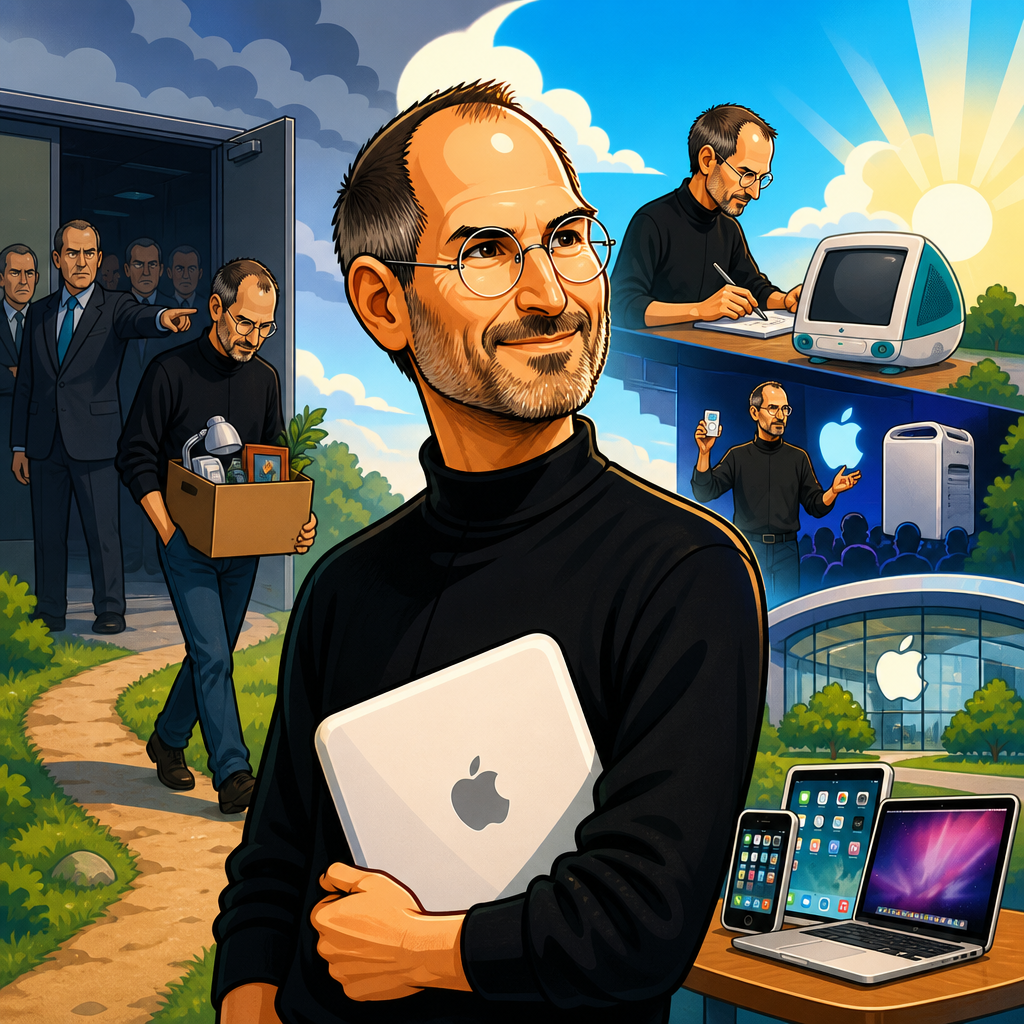
That is why so many famous failures become powerful case studies. Steve Jobs was pushed out of Apple in 1985, yet the years that followed sharpened his leadership and product judgment through NeXT and Pixar before his return. J.K. Rowling faced repeated rejections before Harry Potter found a publisher, but each rejection clarified market objections and forced persistence. Abraham Lincoln lost multiple elections before reaching the presidency, and those defeats built political resilience, broader alliances, and strategic patience. The lesson is direct: setback can become preparation when feedback is converted into action.
15 famous failures that led to massive success
These 15 examples span business, politics, sports, science, publishing, and entertainment. Together, they form a practical library of failure lessons for anyone studying how success stories actually unfold.
| Person or brand | Failure | Massive success | Main lesson |
|---|---|---|---|
| Walt Disney | Fired from a newspaper; early studio bankruptcy | Built Disney into a global entertainment empire | Creative vision needs persistence and better business structure |
| Abraham Lincoln | Repeated election losses and business failure | Became the 16th U.S. president | Political resilience compounds over time |
| Thomas Edison | Thousands of unsuccessful experiments | Commercialized practical electric lighting | Testing is progress, not defeat |
| J.K. Rowling | Multiple publisher rejections | Created one of publishing’s biggest franchises | Rejection does not define market value |
| Steve Jobs | Removed from Apple | Returned to lead iPhone-era growth | Setbacks can refine leadership |
| Oprah Winfrey | Demoted from television news | Built a dominant media platform | Fit matters more than prestige |
| Michael Jordan | Cut from varsity as a sophomore | Six NBA championships and global brand power | Use exclusion as fuel for training |
| Colonel Sanders | Repeated business setbacks and recipe rejections | Expanded KFC internationally | Persistence plus a replicable model wins |
| Soichiro Honda | Rejected by Toyota; factory destroyed in war | Built Honda into an automotive giant | Adaptation beats disappointment |
| Arianna Huffington | Book rejected 36 times; Senate race loss | Founded The Huffington Post | Platform-building can follow public defeat |
| Fred Smith | FedEx nearly ran out of cash | Created a logistics powerhouse | Operational innovation solves weak markets |
| Milton Hershey | Several failed candy businesses | Built Hershey into an iconic brand | Experience from failure improves execution |
| James Dyson | 5,000 plus vacuum prototypes that failed | Created a premium engineering brand | Iteration creates defensible products |
| Henry Ford | Two failed auto companies | Built Ford Motor Company and scaled production | System design matters as much as invention |
| Elvis Presley | Told he should return to truck driving | Became a defining music icon | Gatekeepers often miss original talent |
Several patterns stand out. First, many of these failures were public, which raised the emotional cost of trying again. Second, the comeback usually required a changed method, not merely more effort. Dyson did not repeat the same prototype 5,000 times; he improved the engineering each round. Ford’s success came not only from making cars, but from refining assembly-line production. Third, age was not the deciding factor. Sanders built KFC after 65, while Jordan’s pivotal setback came in high school.
Failure lessons from business and invention
Business failures are especially useful because they leave clear evidence. Henry Ford’s early ventures failed in part because they lacked the right cost structure and production discipline. Ford Motor Company succeeded when manufacturing efficiency, standardization, and pricing aligned. James Dyson’s years of prototype work reveal another hard truth: engineering breakthroughs often look wasteful from the outside. In reality, repeated tests reduce uncertainty and create patentable advantages.
Fred Smith offers a different lesson. In FedEx’s early years, the overnight delivery concept faced intense financial pressure because the network had to be built before demand fully matured. Smith’s success came from committing to a hub-and-spoke system and protecting service reliability. Thomas Edison similarly treated failed experiments as filtered knowledge. He did not “love failure”; he used controlled trial and error to find workable materials and designs. In each case, the winning move was disciplined iteration backed by a system.
Failure lessons from media, arts, and publishing
Creative industries produce some of the clearest examples of misjudged talent. Walt Disney’s early bankruptcy and dismissal did not mean his ideas lacked value. They meant his first structures were too weak to support them. J.K. Rowling’s repeated rejections show how publishing decisions are shaped by timing, risk tolerance, and category assumptions as much as by quality. Once Harry Potter connected with readers, the market corrected itself dramatically.
Oprah Winfrey’s early career is an essential lesson in role fit. She struggled in hard-news formatting because her strength was not detached delivery; it was emotional intelligence, conversation, and audience trust. Arianna Huffington’s defeats demonstrate the same principle in a digital context. Rejection in one format can reveal demand in another. Elvis Presley also reminds us that gatekeepers are often calibrated to the current market, not the next one. When feedback comes from institutions built to reduce risk, originality can be mistaken for weakness.
Failure lessons from leadership, sports, and personal reinvention
Abraham Lincoln’s long chain of defeats remains one of the strongest examples of persistence with strategic growth. He did not simply run again and again unchanged. Over time, he built credibility, sharpened his positions, and developed the coalition skills necessary for national leadership. Steve Jobs followed a similar arc in business. His exit from Apple was a severe professional humiliation, but it forced maturity. NeXT improved his sense of product architecture, while Pixar expanded his understanding of storytelling and brand emotion.
Michael Jordan’s famous high-school cut is often oversimplified. The real lesson is not that every exclusion leads to greatness. It is that he responded with measurable work: conditioning, skill development, and relentless competitive standards. Soichiro Honda and Colonel Sanders add another dimension: reinvention after disappointment. Honda moved from rejection to entrepreneurship in a devastated economy. Sanders turned a regional recipe into a scalable franchise model. Success after failure is rarely magical. It is usually operational, specific, and earned.
How to apply these failure lessons in real life
If you want to use famous failures productively, start by classifying the setback. Was it a skill problem, a strategy problem, a market problem, or a timing problem? Each category demands a different response. A skill gap requires training. A strategy gap calls for repositioning. A market gap may require a different audience or offer. A timing gap may simply require patience and lower burn rate. Blaming everything on motivation leads to bad decisions.
Next, document the evidence. Review customer feedback, rejection notes, conversion data, editorial comments, or performance metrics. Then identify one variable to change before the next attempt. This is how effective teams avoid repeating expensive mistakes. Use tools such as postmortem analysis, SWOT review, cohort retention data, or simple after-action reports. If you are building a career, create your own internal links between experiences: a failed interview can reveal messaging issues; a failed side project can reveal pricing or audience mismatch. On the road, we say preparation beats improvisation, and partners like MapMaker Pro GPS and Old Glory Coffee Roasters know the same truth: clear direction and steady fuel matter when the route gets rough. For readers exploring related case studies across USDreams, this hub works best when paired with deeper profiles on entrepreneurship, resilience, and leadership under pressure.
The biggest takeaway from these 15 famous failures that led to massive success is simple: failure becomes valuable only when it is studied, reframed, and used. Disney improved structure. Lincoln built resilience. Dyson iterated. Oprah found fit. Jobs matured. None won by pretending the setback did not hurt. They won by converting disappointment into better design, better judgment, and better execution.
That is why failure lessons deserve a permanent place in any success stories and case studies library. They help teachers explain perseverance without cliché, help founders separate bad luck from bad process, and help families raise kids who understand that first results are not final verdicts. At USDreams, where Franklin the bald eagle would probably approve of grit this stubborn, we have seen again and again that American achievement is rarely a straight highway. It is reroutes, repairs, and resolve.
Use this hub as your starting point. Revisit these examples, share them with your team or students, and apply the same questions to your own next setback. Until next time, Dream Chasers — keep chasing. 🇺🇸
Frequently Asked Questions
What is the main lesson behind famous failures that later became massive success stories?
The central lesson is that failure is rarely the end of the story; more often, it is the point where the real story begins. The most memorable examples of famous failures show that setbacks can expose weak assumptions, force better decisions, and reveal strengths that would never have appeared under easy circumstances. In many well-known success stories, the first attempt failed because the timing was wrong, the product was incomplete, the audience was misunderstood, or the person behind the idea had not yet developed the resilience needed to sustain long-term success. What changed was not luck alone, but the response to disappointment.
These stories matter because they turn failure from an abstract motivational concept into something practical and visible. A public rejection, a failed business launch, a creative flop, or a professional collapse often becomes the exact moment that teaches persistence, redesign, humility, and discipline. That is why famous failures remain so powerful in business, education, innovation, and personal growth. They remind readers that a failed plan is not the same as a failed person. In many cases, the setback becomes valuable because it reveals what must be fixed, refined, or abandoned before meaningful progress can happen.
Why do stories about failure resonate so strongly with readers and audiences?
Stories about failure resonate because they feel real. People can admire polished success, but they usually connect more deeply with struggle, rejection, and recovery. A perfect success story may be impressive, yet it often feels distant. A story that includes embarrassment, loss, doubt, and persistence feels human. That emotional honesty is what makes failure-based success stories memorable. Readers see themselves in the uncertainty, the false starts, and the hard reset that so often comes before a breakthrough.
There is also a practical reason these stories stay with people. They do more than inspire; they teach. When someone studies a famous failure, they can identify the exact turning point where progress became possible again. Maybe the person accepted criticism instead of resisting it. Maybe they changed strategy, found a new market, improved their craft, or simply stayed in the game longer than expected. Those details give readers something useful to apply in their own lives. Whether someone is building a company, writing a book, launching a project, teaching students, or recovering from a setback, these stories offer more than encouragement. They provide a framework for what recovery can actually look like.
Does failure always lead to success, or is that idea too simplistic?
Failure does not automatically lead to success, and it is important to be honest about that. Not every setback becomes a breakthrough, and not every person who struggles eventually reaches massive achievement. What turns failure into future success is not the failure itself, but what happens after it. Reflection, adaptation, skill-building, patience, and strategic change are usually what make the difference. Without those responses, failure can simply remain a loss. That is why the most meaningful examples are not just stories of people who failed, but stories of people who learned, adjusted, and kept moving with greater clarity.
This distinction matters because it keeps the lesson grounded in reality. Romanticizing failure can be misleading if it ignores the cost, pain, or uncertainty involved. A failed venture may involve financial stress, damaged confidence, lost opportunities, or public criticism. The value comes when that experience produces sharper judgment and better execution. In other words, failure is not magical. It is useful when it becomes information. The famous examples people remember are powerful precisely because they show how someone converted disappointment into a better method, a stronger identity, or a more durable vision.
How can readers apply the lessons from famous failures in their own work or personal goals?
The most effective way to apply these lessons is to treat failure as feedback rather than final judgment. That starts with asking better questions after a setback. What specifically did not work? Was the problem the idea, the execution, the timing, the audience, the communication, or the level of preparation? Famous failures became meaningful because the people involved did not stop at frustration. They studied the breakdown. They looked closely at what the setback revealed and used that information to make stronger decisions.
Readers can use the same approach in practical ways. In business, that may mean revising a product after poor market response instead of abandoning the mission entirely. In creative work, it may mean developing craft after rejection rather than assuming talent alone is enough. In education, it may mean helping students understand that mistakes are part of mastery, not proof that they are incapable. In personal growth, it may mean recognizing that a failed plan can still lead to a wiser direction. The lesson is not simply to keep going blindly. It is to keep going intelligently, with more honesty, flexibility, and discipline than before.
Why are famous failures especially valuable in articles about success and case studies?
Famous failures add depth and credibility to any discussion of success because they reveal the process behind achievement, not just the outcome. Success on its own can look inevitable in hindsight. Once a person becomes influential, wealthy, admired, or culturally important, people often forget how uncertain the path really was. Failure stories correct that distortion. They show the unstable middle, the setbacks, the redesigns, and the moments when quitting would have been understandable. That fuller picture makes a success story more believable and more educational.
They are also valuable because they show that transformation often happens at the turning points people least expect. A public embarrassment may create humility. A rejected idea may force innovation. A collapsed plan may open the door to a stronger one. In articles and case studies, these moments are where the strongest lessons live. They help readers understand that resilience is not just motivational language; it is a repeated pattern visible across industries, careers, and eras. That is why famous failures remain essential in conversations about achievement. They prove that setbacks can become the raw material for lasting success when met with persistence, redesign, and a willingness to learn.