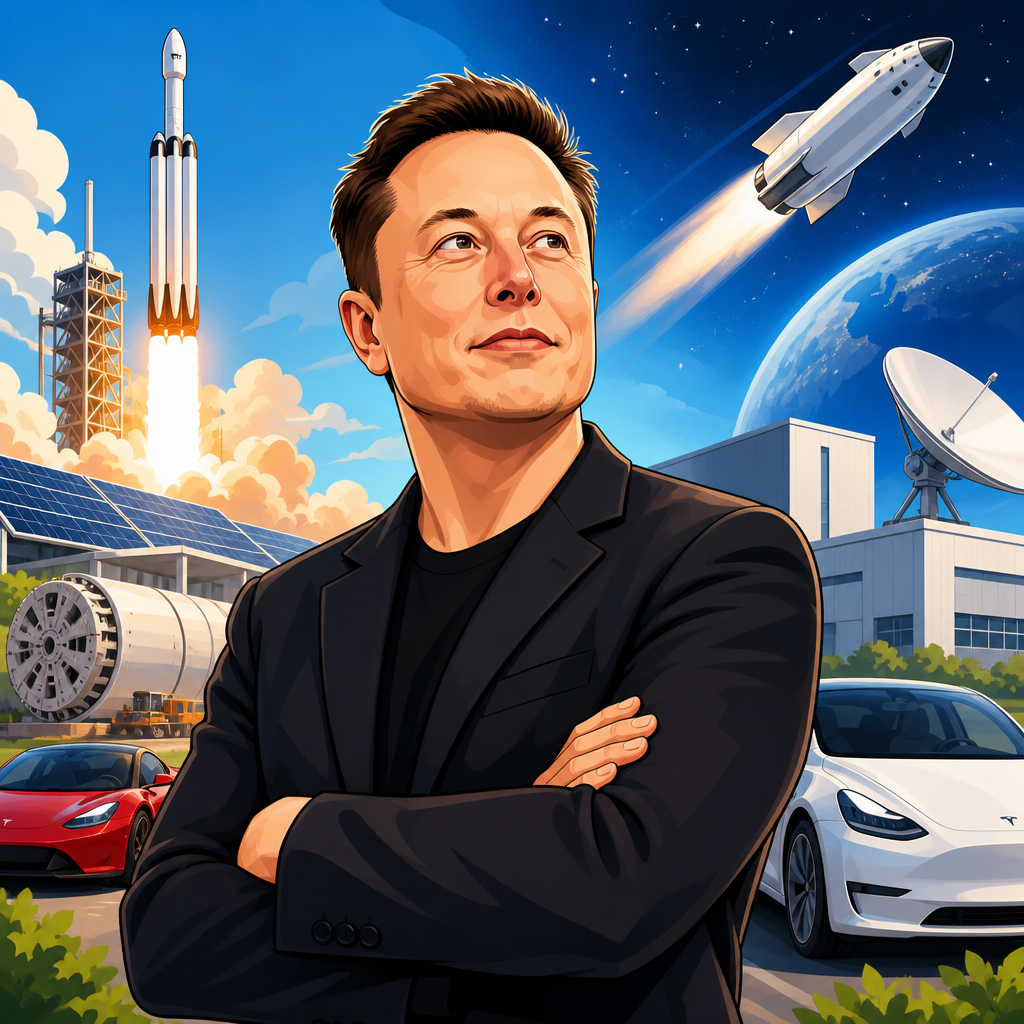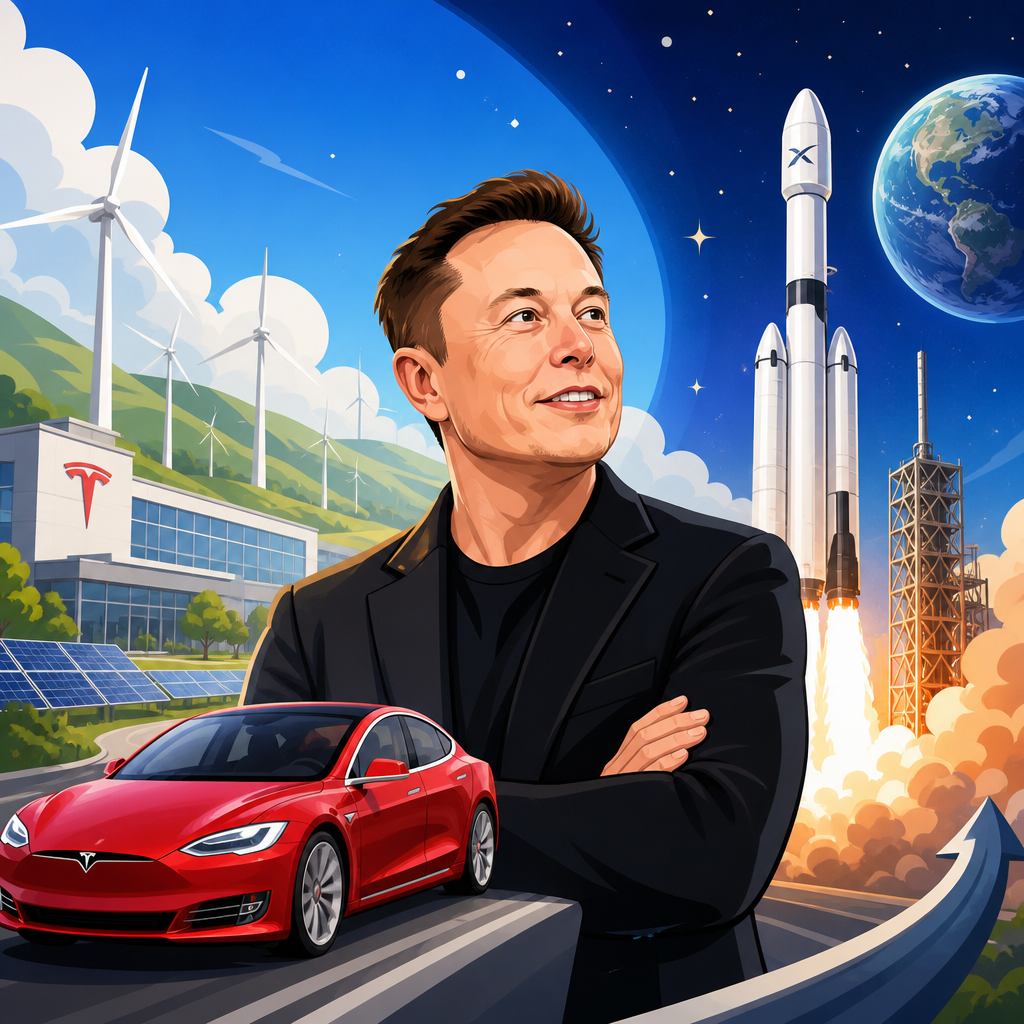
There are places in America that don’t just tell history — they make you feel it. The rise of Tesla and SpaceX feels a bit like standing at Cape Canaveral or touring the Rouge plant: you witness ambition scaled into steel, software, and systems. As a hub article on entrepreneur success stories, this guide explains what the Tesla and SpaceX case study teaches about innovation, leadership, execution, and risk. Tesla is the electric vehicle and energy company that pushed battery-powered transportation into the mainstream. SpaceX is the private aerospace company that cut launch costs and normalized reusable rockets. Together, they offer one of the clearest modern examples of how a founder-led vision can reshape entrenched industries.
Why does this matter to Dream Chasers, business owners, and anyone studying success stories? Because these companies did not win by chasing easy markets. They entered sectors with brutal capital requirements, heavy regulation, sophisticated incumbents, and low tolerance for failure. In my work analyzing business case studies, the most useful examples are not the smooth ones; they are the stories where strategy met resistance and still found traction. Tesla and SpaceX are valuable because they reveal how great companies combine product conviction, engineering discipline, talent density, and public storytelling. They also show the limits of charisma. Vision opens doors, but manufacturing yield, supply chains, safety protocols, and unit economics keep them open.
These lessons are especially useful for readers building a subtopic map around entrepreneur success stories. A good hub page should define the recurring patterns behind standout companies: a sharp mission, timing, differentiated technology, disciplined operations, and a willingness to survive near-failure moments. That is the red, white, and blueprint approach to studying business history. Tesla and SpaceX did not follow identical paths, yet both translated long-range missions into concrete milestones. That makes them ideal anchors for related articles on innovation strategy, founder leadership, fundraising, branding, operational scaling, and crisis management.
Start with a mission big enough to organize talent and capital
The first lesson from Tesla and SpaceX is that mission is not decoration; it is an operating system. Tesla’s early purpose was to accelerate the world’s transition to sustainable energy. SpaceX aimed to make life multiplanetary while first lowering the cost of access to space. Those statements were larger than any single product, and that mattered. Talented engineers, operators, and investors often accept hard tradeoffs when they believe the mission has historic weight. I have seen this dynamic repeatedly: the strongest candidates join for meaning, then stay when the work proves technically serious.
Mission also sharpens strategic decisions. Tesla was never only a carmaker. Its roadmap connected sports cars, premium sedans, mass-market vehicles, batteries, charging infrastructure, solar, and grid storage into one energy ecosystem. SpaceX was never only a launch provider. Falcon 1, Falcon 9, Dragon, Starlink, and Starship each fit a larger plan to reduce launch cost, increase launch cadence, and build deep capability in spacecraft operations. When a company has that level of coherence, outside observers may disagree with the pace, but they can still understand the logic.
Founders often think they need a perfect business plan to attract support. In practice, a credible long-term mission paired with measurable short-term wins is more powerful. Tesla used the Roadster to prove electric performance before moving toward higher-volume vehicles. SpaceX used Falcon 1 to establish viability before scaling to Falcon 9 and crewed missions. Big vision works best when broken into proof points.
Use staged execution to enter impossible markets
Neither company attacked its market in one leap. That is the second lesson. Entrepreneurs entering difficult sectors need staged execution, where each milestone finances, validates, or derisks the next one. Tesla’s 2006 “Secret Master Plan” described a sequence: build a low-volume expensive car, use that money to build a more affordable car, then build an even more affordable mass-market car. The Roadster was niche, but it changed perception. Model S established legitimacy in the premium market. Model 3 chased scale, though not without painful production bottlenecks.
SpaceX followed a similarly staged pattern. Falcon 1 failed three times before reaching orbit in 2008 on its fourth flight. That single success was existential. Soon after, NASA awarded SpaceX a Commercial Resupply Services contract, providing revenue and credibility. Falcon 9 then expanded payload capability, Dragon added cargo and crew transport, and booster recovery created the foundation for reusability economics. In both stories, the companies survived by turning one solved problem into the right to tackle the next.
| Company | Early Milestone | Why It Mattered | Follow-on Advantage |
|---|---|---|---|
| Tesla | Roadster launch in 2008 | Proved EVs could be desirable and high performance | Brand strength for Model S and investor confidence |
| Tesla | Model 3 production ramp | Tested ability to move from niche to scale | Higher volume, broader market access, data at fleet scale |
| SpaceX | Falcon 1 reaches orbit in 2008 | Validated core engineering capability after repeated failures | Enabled major contracts and deeper capital support |
| SpaceX | Falcon 9 booster landings | Demonstrated reusable launch economics | Lower launch costs and faster cadence |
For entrepreneurs, the takeaway is direct: do not confuse the ultimate vision with the first product. Sequence matters. The best case studies show an intentional path from proof to scale.
Vertical integration can be a moat when speed and quality matter
A third lesson is that vertical integration is not old-fashioned; it is often a strategic necessity. Tesla built unusual control over batteries, software, drivetrain technology, charging, and retail experience. SpaceX brought propulsion, avionics, structures, software, and launch operations in-house to a degree rare in aerospace. This was not ideology for its own sake. It was a response to supply chains that were too slow, too expensive, or too compromised by legacy assumptions.
The benefit of vertical integration is tighter feedback loops. When engineering, manufacturing, and software teams work across the same system, problems surface faster and fixes travel faster. Tesla updates vehicle software over the air, captures fleet data, and iterates both code and hardware decisions with unusual speed for the auto sector. SpaceX uses integrated design and manufacturing to shorten development cycles and reduce contractor markup. That helped it underprice many incumbents while improving launch cadence.
But this lesson has a warning label. Vertical integration raises complexity, capital intensity, and management burden. It works when the company has exceptional technical leadership and enough volume to justify internal capability. Many founders would be wiser to integrate selectively around their differentiators and outsource the rest. The Tesla and SpaceX example is instructive precisely because it is hard to copy.
Brand, storytelling, and customer evangelism amplify technical advantage
Products alone rarely create category shifts. Tesla and SpaceX benefited from storytelling powerful enough to attract customers, talent, media attention, and patient capital. Tesla turned electric vehicles from a compromise into a status symbol and identity marker. Owners became evangelists because the product gave them something worth talking about: acceleration, minimalist design, charging access, software updates, and a sense of participating in the future. SpaceX did something similar in aerospace by making launches culturally visible again. Rocket landings became shareable proof of progress.
This matters for entrepreneur success stories because narrative reduces customer acquisition friction. A company with a vivid mission and visible milestones earns disproportionate attention. That attention lowers recruiting costs, strengthens partnerships, and creates resilience during setbacks. I have watched lesser products outperform better ones simply because the better company failed to explain why its work mattered. Tesla and SpaceX never made that mistake.
Still, storytelling cannot permanently outrun operational reality. Tesla has faced criticism over service, quality variance, and delayed timelines. SpaceX operates in a domain where failure is public and safety is paramount. In both cases, narrative was most effective when backed by undeniable technical progress. That is the standard entrepreneurs should adopt.
Near-failure moments often define the success story
One reason these companies belong at the center of any entrepreneur success stories hub is that both survived moments that would have ended most ventures. In 2008, Tesla struggled with cost overruns and financing pressure during the financial crisis. SpaceX had burned through early launch attempts and needed Falcon 1’s fourth flight to succeed. Those were not cinematic details added later; they were genuine survival tests.
What separated them from failed peers was a mix of persistence, access to capital, and ruthless prioritization. During crisis periods, strong founders narrow focus to mission-critical outcomes. They raise bridge funding, cut nonessential work, and push teams toward the milestone that unlocks the next tranche of trust. This does not romanticize chaos. Constant emergency is unhealthy. But entrepreneurs should understand that resilience is usually built during compressed, uncomfortable stretches, not during stable quarters.
The deeper lesson is practical: define the one milestone that changes your company’s odds of survival, then align money, talent, and time around it. For Tesla, that often meant production and delivery targets tied to confidence in future demand. For SpaceX, it meant launch success, NASA trust, and reusable system reliability. Heroes of industry still answer to physics and cash flow.
What founders, investors, and readers should study next
Tesla and SpaceX teach that extraordinary companies are built where vision, engineering, operations, and communication intersect. They show that ambitious missions can pull in top talent, that staged execution can open hostile markets, that vertical integration can create speed and quality advantages, and that public narrative works best when tied to measurable progress. They also show the cost of ambition: long hours, operational strain, reputational risk, and frequent scrutiny. Anyone studying entrepreneur success stories should take the full lesson, not just the glamorous part.
For USDreams readers, these stories fit the American tradition of betting on difficult frontiers, from railroads to aviation to the space age. They reward the same spirit behind The Great American Rewind: respect the past, but move with purpose toward what comes next. If you are building a business, teaching a class, or mapping related case studies, use this article as your starting point, then explore deeper topics such as scaling strategy, innovation culture, founder branding, and capital formation. Franklin would probably approve, and so would anyone fueled by Old Glory Coffee Roasters on a late-night planning session. Until next time, Dream Chasers — keep chasing. 🇺🇸
Frequently Asked Questions
1. What is the biggest lesson entrepreneurs can learn from the rise of Tesla and SpaceX?
The biggest lesson is that category-changing companies are rarely built by improving the status quo a little at a time. Tesla and SpaceX both succeeded by pursuing ambitious, high-stakes goals that many established players considered unrealistic. Tesla did not enter the market trying to become a slightly better car company; it set out to accelerate the world’s transition to sustainable energy. SpaceX did not position itself as a modest aerospace supplier; it aimed to radically lower the cost of access to space and make rockets reusable. That scale of mission matters because it shapes hiring, product decisions, investor interest, customer enthusiasm, and long-term resilience.
For entrepreneurs, the practical takeaway is not simply “think big,” but “align bold vision with relentless execution.” Vision alone does not produce durable companies. Tesla had to solve manufacturing bottlenecks, battery scaling, charging infrastructure, software integration, and supply chain complexity. SpaceX had to master propulsion, testing, launch operations, materials engineering, and regulatory compliance while absorbing repeated failures. In both cases, the lesson is that breakthrough success comes from pairing mission-driven ambition with a willingness to do the difficult operational work that others avoid.
Another major lesson is that conviction often has to outlast public skepticism. Both companies faced doubts from experts, media, competitors, and investors at different stages. Yet they kept pushing because they were built around a clear thesis: if a product is dramatically better, more efficient, or more scalable, markets can eventually shift in ways that look impossible early on. Entrepreneurs reading this case study should understand that transformative growth often looks messy and improbable before it looks inevitable.
2. How did Tesla and SpaceX use innovation differently from traditional companies?
Tesla and SpaceX approached innovation as a full-system challenge, not just a product feature exercise. Traditional companies often innovate incrementally within established constraints: a better engine, a cheaper component, a slightly faster process. Tesla and SpaceX were more willing to question the assumptions underneath the industry itself. Tesla rethought the car as a software-enabled, battery-centered platform connected to charging infrastructure, energy storage, and over-the-air updates. SpaceX rethought rockets not as single-use machines but as reusable systems that could fundamentally change launch economics.
One of the clearest differences was vertical integration. Rather than outsourcing as much as possible and operating like coordinators of third-party suppliers, both companies brought critical capabilities closer to the core of the business. That gave them more control over speed, quality, iteration, and intellectual property. For Tesla, that meant deeper involvement in batteries, vehicle software, manufacturing systems, and charging networks. For SpaceX, it meant owning more of the engineering and production stack so it could iterate faster and reduce dependency on legacy aerospace suppliers. This model is demanding, but it can create a powerful advantage when innovation speed is more important than short-term efficiency.
They also treated iteration as a strategic capability. Instead of waiting for perfect certainty, both organizations tested, learned, adjusted, and improved continuously. In aerospace, that looked like repeated launches, failures, redesigns, and eventually successful recovery and reuse. In automotive and energy, it looked like rapid product updates, software-driven improvements, manufacturing changes, and aggressive scaling despite setbacks. The broader lesson for founders is that innovation becomes much more effective when it is embedded in engineering culture, operational design, and leadership expectations rather than confined to a research department.
3. What does the Tesla and SpaceX story teach about leadership and company culture?
The story of Tesla and SpaceX shows that leadership at high-growth, high-complexity companies must do more than inspire. It must create urgency, enforce standards, and keep teams aligned around outcomes that are difficult, measurable, and mission-critical. In both companies, leadership helped define a culture where ambitious goals were not treated as branding language but as operational commitments. That kind of culture can be intense, but it also attracts people who want to solve meaningful, technically demanding problems.
A central leadership lesson is that clarity matters. Teams perform better when they understand why the company exists, what problem it is trying to solve, and what tradeoffs it is willing to make. Tesla’s mission connected transportation, energy storage, and infrastructure into a larger narrative about sustainability. SpaceX’s mission connected rocket engineering, launch economics, and long-term space access into a story about expanding what humanity can do. That level of clarity helps companies recruit mission-oriented talent and sustain momentum during periods of failure or criticism.
At the same time, these examples also reveal the risks of hard-driving leadership cultures. High standards can produce extraordinary results, but they can also create burnout, internal strain, and controversy if not managed carefully. So the lesson for entrepreneurs is not to imitate intensity for its own sake. The real lesson is to build a culture of accountability, technical rigor, speed, and ownership while also developing management systems that support people over the long term. Strong leadership is not just about demanding excellence; it is about turning ambition into repeatable execution without losing organizational coherence.
4. Why were execution and manufacturing so important to Tesla and SpaceX’s success?
Execution is where bold ideas either become reality or collapse under their own complexity. Tesla and SpaceX are often discussed as innovation stories, but they are equally execution stories. In fact, one of the clearest lessons from both companies is that breakthrough vision is not enough if the organization cannot manufacture, test, deliver, and scale consistently. This is especially true in industries that involve hardware, infrastructure, safety, logistics, and capital intensity.
Tesla’s rise demonstrated that building a desirable electric car was only one part of the challenge. The harder part was producing vehicles at scale, maintaining quality, sourcing batteries, managing factories, and creating an ecosystem that made adoption practical. The company’s production struggles became a defining reminder that manufacturing is not a side issue; it is often the business model in physical-product industries. SpaceX faced a parallel reality. Designing rockets was one challenge, but executing launches reliably, recovering boosters, reducing turnaround times, and controlling costs at scale required extraordinary discipline across engineering and operations.
For entrepreneurs, the key insight is that execution compounds just like innovation does. Better manufacturing, faster feedback loops, stronger supply chains, tighter quality control, and more integrated operations can create powerful advantages over time. Many founders underestimate how much value is created not by the initial idea, but by the company’s ability to operationalize that idea better than anyone else. Tesla and SpaceX remind us that scale is won in factories, testing facilities, launch pads, software systems, and logistics networks—not only in presentations or product announcements.
5. What do Tesla and SpaceX teach about risk-taking, failure, and long-term thinking?
Tesla and SpaceX show that meaningful disruption usually requires accepting forms of risk that incumbents prefer to avoid. Both companies entered industries with high barriers to entry, major capital requirements, complex regulation, and deeply entrenched competitors. That alone made them unusual. But the deeper lesson is that they embraced intelligent, mission-linked risk rather than reckless experimentation. Their bets were large, but they were tied to clear strategic beliefs: electric vehicles would eventually outperform combustion vehicles, and reusable rockets would eventually transform launch economics.
Failure also played a visible role in both stories. SpaceX famously endured failed launches before achieving success, and Tesla went through production delays, financial pressure, and repeated doubts about whether it could scale. These setbacks were not incidental; they were part of the process of solving exceptionally hard problems. What matters for entrepreneurs is how failure is handled. In strong organizations, failure becomes data, diagnosis, and redesign. It is not romanticized, but it is also not treated as final when the underlying opportunity remains sound and the team can learn quickly.
Long-term thinking may be the most underrated lesson of all. Both companies invested in capabilities that did not deliver immediate, easy wins but created strategic leverage over time. Tesla invested in battery technology, software, and charging infrastructure. SpaceX invested in reusability, launch cadence, and integrated engineering. These choices often looked expensive or inefficient in the short run, but they positioned the companies to build advantages that were difficult to replicate. For founders and business leaders, the takeaway is clear: if the vision is real and the fundamentals are strong, long-term investments in technology, systems, and capability can become the foundation of enduring market leadership.