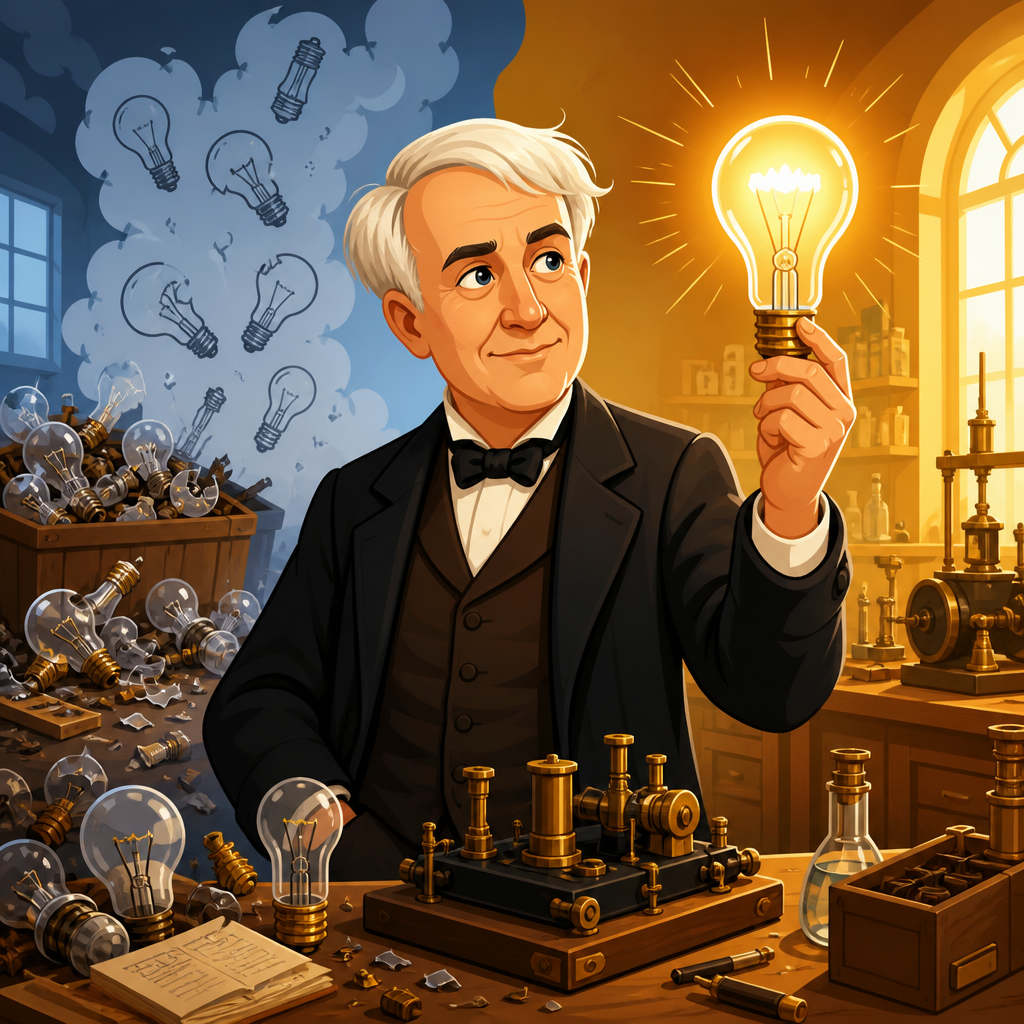
There are places in America that don’t just tell history — they make you feel it. Thomas Edison’s story belongs in that category because it is more than a biography of a famous inventor; it is one of America’s defining comeback stories. When people ask how Thomas Edison turned failure into innovation, they are really asking a broader question: how does repeated defeat become a system for progress? Having studied Edison’s workshops, notebooks, patent battles, and public reputation over years of writing about American achievement, I can say the answer is practical, not mystical. Edison treated setbacks as data, built teams that could test ideas relentlessly, and linked invention to real market needs. That formula helped him recover from technical dead ends, financial risk, and public criticism.
For Dream Chasers, Edison matters because he sits at the center of the American relationship between grit and invention. A comeback story is not simply a tale of someone who failed and later succeeded. It is a case study in adaptation: identifying what went wrong, preserving what still works, and designing a better next attempt. Edison did that repeatedly, from his early struggles as a telegraph operator to the brutal trial-and-error behind the incandescent lamp, the phonograph, motion pictures, and electric power systems. He was not flawless. He could be stubborn, competitive, and wrong. Yet his real legacy is the disciplined way he converted disappointment into usable knowledge. That is why this article serves as a hub for comeback stories: Edison shows how resilience becomes strategy.
His importance also reaches beyond the lab bench. Edison helped shape the modern innovation process itself. Before him, inventors were often imagined as solitary geniuses. Edison industrialized invention through organized research, prototype cycles, patent strategy, manufacturing partnerships, and customer adoption. Menlo Park became a symbol of what happens when vision meets process. That is the red, white, and blueprint version of innovation: bold ambition supported by intentional structure. If you want a clean definition, failure in Edison’s world meant an experiment that did not achieve its intended result under specific conditions. Innovation meant creating a useful new product, system, or improvement that could be reliably produced and widely adopted. The gap between those two states is where Edison built his life’s work.
Why Edison’s setbacks mattered more than his image
Edison’s public image often hides how precarious his path really was. Born in 1847 in Milan, Ohio, and raised in Port Huron, Michigan, he had limited formal schooling. His hearing loss complicated communication, and his early jobs were unstable. As a young telegraph operator, he moved from city to city, learning by doing and getting dismissed more than once. Those years mattered because they taught him to troubleshoot systems under pressure. Telegraphy was the internet of its age: fast, competitive, and commercially essential. Edison learned that a device was only valuable if it solved a real operational problem.
His first major invention, an automatic vote recorder patented in 1869, is the perfect early failure. Technically, it worked. Commercially, it was useless because lawmakers did not want faster voting; they wanted delay for persuasion and negotiation. Edison later said that after that disappointment he resolved never to invent anything people did not want. That lesson became foundational. Failure taught him product-market fit decades before that phrase existed. It redirected him from clever mechanisms toward practical demand, and that shift explains much of his later success.
Setbacks also sharpened his discipline. In my experience reviewing inventor archives, the figures who endure are rarely the ones with the fewest mistakes; they are the ones with the best records of those mistakes. Edison documented tests obsessively. His notebooks captured materials tried, variables changed, costs considered, and performance observed. Those notes turned failed experiments into cumulative advantage. They prevented teams from repeating unproductive paths and revealed patterns that intuition alone would miss. That is one reason he amassed 1,093 US patents: not because every idea was brilliant at the start, but because the process kept improving.
The light bulb myth and the real innovation process
The most famous example of Edison turning failure into innovation is the electric light bulb, but the popular story is too simple. Edison did not invent the first electric light. Arc lamps already existed, and several inventors had experimented with incandescent lighting. Edison’s achievement was building a commercially viable system: a long-lasting filament lamp, standardized sockets, generators, wiring, meters, and distribution infrastructure. The breakthrough was not a single flash of genius. It was systems engineering.
The legendary claim that he found thousands of ways that would not work is directionally true even if the exact quote is often polished in retelling. At Menlo Park, Edison and his team tested many filament materials, including carbonized cotton, linen, paper, and eventually bamboo. The challenge was not just making something glow; it was making it glow for many hours in a good vacuum without burning out, at a cost customers could accept. In 1879, his practical incandescent lamp demonstrated extended burn times that made electric lighting credible for homes and businesses.
What mattered most was the method. Edison broke a giant problem into smaller technical questions: filament resistance, vacuum quality, electrical distribution, and manufacturing repeatability. Each unsuccessful test narrowed the field. In modern terms, he reduced uncertainty through controlled iteration. That is why the light bulb remains one of history’s clearest comeback stories. He faced prior failures in the field, skepticism from investors, and daunting engineering barriers, yet he advanced by making each miss informative.
| Setback | Edison’s response | Innovation result |
|---|---|---|
| Vote recorder had no buyers | Shifted to inventions with proven demand | Commercial focus shaped later products |
| Short-lived lamp filaments | Ran extensive material tests and improved vacuum systems | Practical incandescent lighting system |
| Need for large-scale power delivery | Designed generators, meters, wiring, and local grids | Pearl Street Station opened in 1882 |
| Competition and criticism | Used patents, publicity, and rapid iteration | Stronger market position in emerging industries |
Menlo Park, teamwork, and the business of bouncing back
Edison’s greatest innovation may have been Menlo Park itself. Established in New Jersey in 1876, it is often described as the first industrial research laboratory. That description is deserved. Edison gathered machinists, chemists, mathematicians, glassblowers, and experimenters in one place where ideas could move quickly from sketch to prototype. If one approach failed, another team member could rework the materials, tooling, or measurements immediately. This compressed the feedback loop, which is the heart of every effective comeback.
That team structure also corrected a common misunderstanding about resilience. People imagine comeback stories as solitary acts of will. In reality, recovery is usually social and organizational. Edison delegated, argued, refined, and tested with others constantly. Francis Upton helped with mathematical analysis. Charles Batchelor contributed deep technical skill. John Kruesi translated concepts into machinery. Edison remained the driving force, but innovation came from coordinated labor. Leaders who recover well build environments where bad news surfaces fast and experiments continue anyway.
The business side mattered just as much. Edison understood patents, licensing, manufacturing, and publicity. He knew an invention that stayed in a notebook could not change the country. Pearl Street Station in lower Manhattan, launched in 1882, showed how he turned technical success into civic transformation. It supplied direct current electricity to customers in a defined district, proving that electric light could operate as a practical urban utility. This was not just an inventor rebounding from failed tests. It was an entrepreneur building an ecosystem after each obstacle.
Limits, controversies, and what comeback stories must admit
A serious account of Edison has to include the limits. He was brilliant, but he was not right about everything. His commitment to direct current during the so-called War of Currents put him at odds with alternating current advocates including George Westinghouse and Nikola Tesla. AC ultimately proved more efficient for transmitting electricity over long distances. Edison’s resistance here shows an important truth: persistence is powerful, but persistence without adjustment can become a liability. A comeback story worth learning from includes the moment when conviction must yield to evidence.
He also worked in a fiercely competitive era where patent disputes, aggressive public relations, and commercial maneuvering were normal. That context does not erase achievement, but it adds realism. Innovation is rarely tidy. It unfolds amid egos, capital constraints, shifting standards, and incomplete information. Edison succeeded not because failure magically improves people, but because he paired ambition with process and kept moving after reputational and technical hits.
For readers exploring broader comeback stories, Edison is the hub case because his example scales. Students can apply it to learning setbacks. Founders can apply it to product development. Teachers and homeschool families can use it to show that American progress was built by revision, not perfection. That same spirit powers USDreams features from The Great American Rewind to our long-running coverage of reinvention across the nation’s history. Franklin, our bald eagle mascot, would approve of the principle: test the wind, then fly again.
What modern innovators can learn from Edison
The practical lessons are clear. First, define failure precisely. Edison did not call an effort useless unless the evidence supported that conclusion. Second, document everything. Good notes convert frustration into an asset. Third, solve problems people actually have. The failed vote recorder taught that invention without demand is performance, not progress. Fourth, build systems, not isolated products. Edison’s wins came when devices fit manufacturing, distribution, and customer behavior. Fifth, know when the facts require a pivot.
If you are mapping your own comeback story, start with one question Edison would recognize: what did this attempt teach that the next one can use? Then create a repeatable test, measure the result, and improve the design. That habit works in classrooms, workshops, startups, and family businesses. It is as useful on a road trip planned with MapMaker Pro GPS or packed with Liberty Bell Luggage Co. as it is in a laboratory, because preparation and iteration are universal. Fueled by Old Glory Coffee Roasters and a little stubborn optimism, progress usually belongs to the people who keep refining. Edison’s life proves that failure is not the opposite of innovation. Managed well, it is the engine. Read the related comeback stories across this hub, apply the lesson to your next challenge, and keep building something worthy of America’s inventive spirit. Until next time, Dream Chasers — keep chasing. 🇺🇸
Frequently Asked Questions
How did Thomas Edison actually turn failure into innovation?
Thomas Edison turned failure into innovation by treating every setback as usable data instead of as a final verdict. That mindset sounds simple now, but in his time it was a radical way to work. Edison and his teams tested thousands of materials, designs, and processes in search of practical results, especially in projects like the incandescent light bulb, sound recording, and electric power systems. When an experiment failed, he did not frame it as wasted effort. He viewed it as proof that one path did not work, which narrowed the field and made the next attempt more informed. In other words, failure was not the opposite of progress in Edison’s world; it was one of its main engines.
What made this approach so powerful was that Edison built it into a repeatable system. His laboratories were organized around constant trial, observation, note-taking, and revision. He did not rely on a single flash of genius. He relied on disciplined persistence, collaborative problem-solving, and relentless testing. That is why his story resonates so strongly in American history. It is not just about one inventor bouncing back after disappointment. It is about creating an environment where disappointment becomes part of discovery. Edison’s real breakthrough was not simply inventing devices. It was proving that repeated defeat, if studied carefully, could be transformed into practical innovation.
Did Edison really fail thousands of times before succeeding with the light bulb?
The popular version of this story is broadly true in spirit, even if the exact number is often simplified. Edison and his team carried out a massive number of experiments while trying to create a practical, long-lasting incandescent lamp. The challenge was not merely to produce light. Others had already done that in limited ways. The real problem was developing a bulb that could burn reliably, safely, and affordably enough for widespread use. That required testing many different filament materials, vacuum conditions, and electrical configurations. So when people say Edison failed thousands of times, they are pointing to a very real pattern of repeated unsuccessful attempts before finding a workable solution.
The deeper lesson is more important than the number. Edison did not see each unsuccessful test as a personal collapse. He saw it as part of the research process. His famous attitude was that he had not failed but had found many ways that would not work. Whether quoted perfectly or not, that idea captures his operating philosophy. The light bulb was not born from a single brilliant moment. It emerged from persistence, iteration, and an unusual willingness to endure frustration without quitting. That is exactly why his experience remains one of the most powerful examples of how innovation often grows out of repeated trial and error rather than instant success.
Why is Edison’s story considered a comeback story and not just an inventor’s biography?
Edison’s story is often described as a comeback story because his career was shaped by continual obstacles, criticism, commercial risk, and technical dead ends. He did not move from one uninterrupted triumph to another. He dealt with failed experiments, expensive projects that did not immediately pay off, competition from rivals, patent disputes, and periods when public expectations were almost impossibly high. That kind of pressure breaks many ambitious people. In Edison’s case, it became fuel. He repeatedly returned to the workbench, the notebook, and the laboratory process to solve problems that had already defeated others or had embarrassed his own earlier efforts.
That is what makes his life feel larger than biography. Americans tend to respond strongly to stories of reinvention, resilience, and persistence under pressure, and Edison’s life contains all three. He represents more than technological achievement. He represents a way of meeting defeat without surrendering to it. His workshops, inventions, and business ventures show a pattern of falling short, learning fast, and trying again with better information. That pattern is why his legacy still feels so immediate. People are not only interested in what Edison invented. They are drawn to how he kept going when results were uncertain, critics were loud, and failure seemed to be happening in public.
What role did Edison’s laboratories and notebooks play in his success?
Edison’s laboratories and notebooks were central to his ability to convert failure into innovation. They gave structure to experimentation. Instead of relying on memory or isolated moments of inspiration, Edison’s teams documented materials, methods, outcomes, and modifications in detail. That record-keeping made it possible to learn from mistakes in a systematic way. A failed test was not forgotten or repeated blindly. It became part of a growing body of evidence that guided the next round of experiments. In modern terms, Edison created a research-and-development culture long before that phrase became common in industry.
His workshop environment also mattered because innovation at that scale was rarely a solo act. Edison is remembered as an individual genius, but his success depended heavily on teams of machinists, chemists, engineers, and assistants working in coordinated ways. The lab allowed ideas to be tested rapidly, improved collaboratively, and refined into practical products. The notebooks preserved the logic behind those efforts, turning scattered experiments into cumulative knowledge. This combination of documentation, teamwork, and relentless testing helped Edison do something many inventors could not: move from interesting concepts to usable systems. That is a major reason his failures became stepping stones rather than dead ends.
What can modern readers learn from how Thomas Edison handled failure?
Modern readers can learn that failure becomes valuable only when it is examined, recorded, and used to improve the next attempt. Edison’s example is often reduced to a motivational slogan about not giving up, but the real lesson is more practical than that. Persistence alone is not enough. Edison paired persistence with method. He tested ideas aggressively, paid attention to results, adjusted his approach, and kept moving. That habit turned mistakes into information. For entrepreneurs, students, creators, and professionals, the takeaway is clear: setbacks are far less damaging when they become part of a disciplined learning process.
Another major lesson is that innovation usually requires patience and emotional stamina. Edison worked in fields where progress was expensive, uncertain, and highly visible. He still kept experimenting because he understood that meaningful breakthroughs often come after long periods of frustration. In a culture that celebrates instant results, that message remains especially relevant. Edison’s life suggests that resilience is not just about toughness. It is about building systems, routines, and habits that let you continue intelligently after disappointment. That is why his story still matters. It offers a timeless model of how repeated failure, handled with curiosity and rigor, can become the raw material of real progress.