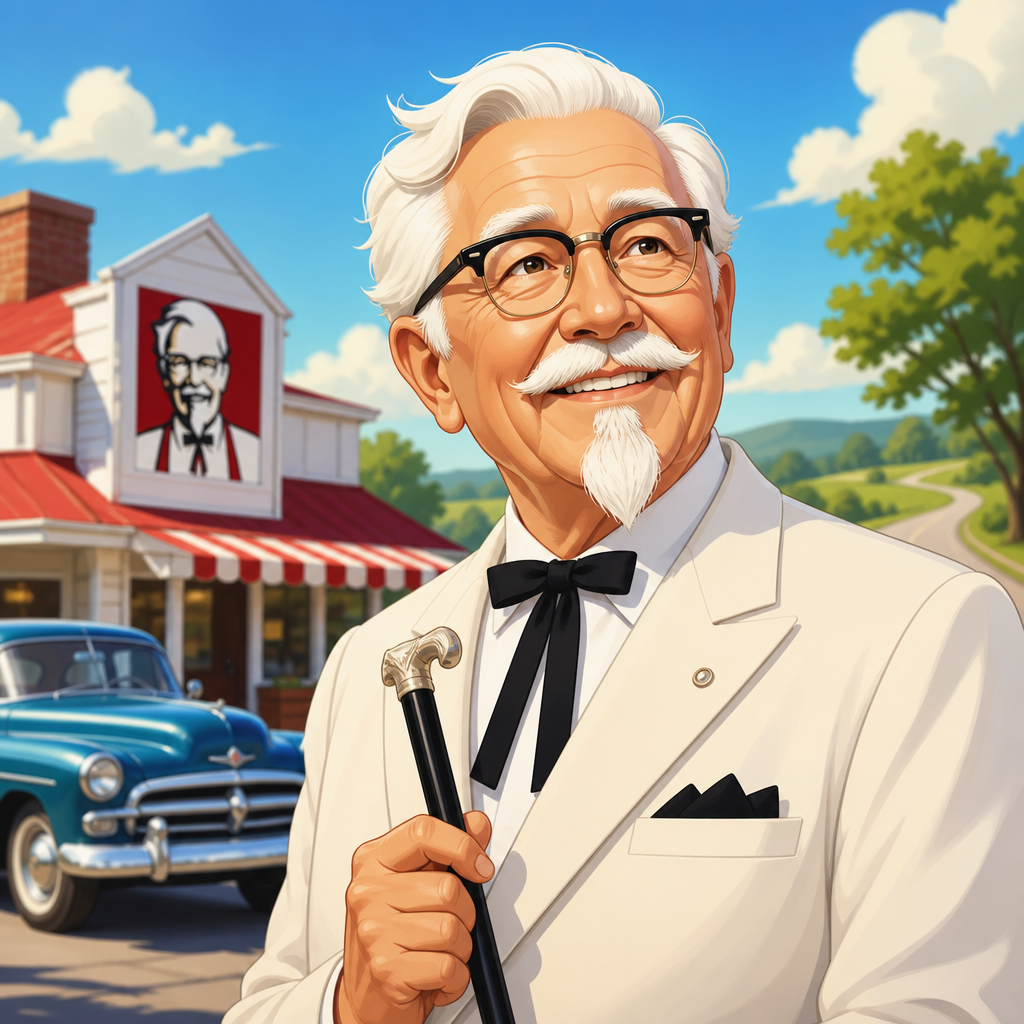
There are places in America that don’t just tell history — they make you feel it. Colonel Harland Sanders belongs in that category, not because he built a battlefield monument or signed a founding document, but because his life became one of America’s clearest comeback stories. The story of Colonel Sanders: success after 60 matters because it overturns one of the most stubborn myths in business and life: that opportunity belongs mainly to the young. In reality, Sanders built the enterprise that made him world-famous after most people had already retired, and he did it through persistence, reinvention, and disciplined brand building.
For Dream Chasers, this is more than a feel-good biography. It is a practical case study in how late-life success happens. A comeback story is not just any second act. It is a measurable recovery after failure, interruption, poverty, rejection, or professional decline. Sanders experienced all of that. Before Kentucky Fried Chicken became a household name, he worked a string of jobs, lost businesses, faced highway rerouting that wrecked his restaurant traffic, and spent years trying to turn one tested chicken recipe into a scalable operation. His breakthrough did not arrive by luck. It came from a repeatable model, relentless salesmanship, and unusually strong quality control.
His story also serves as a hub for understanding comeback stories more broadly. The same patterns appear again and again in American reinvention: a portable skill, a clear offer, proof that the offer works, and stamina under rejection. Sanders had all four. He also understood something many founders miss: people do not buy only a product; they buy trust. His white suit, black string tie, and courtly “Colonel” persona were not random quirks. They were a carefully reinforced signal of consistency, Southern hospitality, and personal accountability. In modern terms, he built one of the strongest founder brands in twentieth-century food history.
Who Colonel Sanders Was Before Fame
Harland David Sanders was born in 1890 in Henryville, Indiana. His father died when he was young, and Sanders learned to cook early while helping care for his siblings. That detail matters because it gave him practical kitchen competence long before he saw food as a business opportunity. Over the years he worked as a farmhand, streetcar conductor, railroad fireman, insurance salesman, and service station operator. This patchwork career is often summarized quickly, but it reveals the core of most comeback stories: the eventual winner is rarely following a straight line. Sanders accumulated sales ability, resilience, customer instincts, and operational discipline across jobs that looked disconnected at the time.
In 1930, he began serving travelers at a Shell service station in Corbin, Kentucky. He did not start with a formal restaurant. He started by feeding hungry motorists in a roadside setting, then expanded into a dining room and motel as demand grew. That progression is textbook entrepreneurial validation. He found a paying audience first and invested later. By the 1930s and 1940s, his fried chicken had become regionally known, and in 1935 Kentucky governor Ruby Laffoon awarded him the honorary title of Kentucky Colonel. The title stuck, but reputation alone did not make him rich. His real challenge was turning local acclaim into a system others could reproduce.
Why Success Came After 60
Sanders was in his sixties when the event that could have ended his career instead forced his reinvention. Interstate planning and road changes reduced traffic near his Corbin restaurant. In plain terms, the cars stopped coming. The business model that depended on passing motorists no longer worked at the same scale. He sold the property and, after debts were settled, reportedly lived on modest Social Security income. This is the stage where many comeback stories become cautionary tales. Sanders went the other direction. Rather than trying to rebuild another full-service restaurant from scratch, he focused on the asset he still owned completely: his chicken recipe and cooking method.
That shift is why his success after 60 is so important. He stopped thinking like a local restaurateur and started thinking like a system creator. Sanders had developed a method using pressure frying to cook chicken faster while preserving moisture and flavor, paired with a seasoning blend that produced a distinctive profile. Restaurants everywhere struggled with the same issue: fried chicken tasted good, but traditional pan-frying took too long for efficient service. Sanders offered a solution with direct economic value. In comeback terms, this is the pivotal move from personal labor to transferable intellectual property.
When I study late-life founders, I look for one question: what exactly became scalable? In Sanders’s case, it was not simply “fried chicken.” It was a repeatable package of recipe, method, brand story, and on-site coaching. He traveled restaurant to restaurant, cooked for owners, and proposed a franchise-style arrangement in which they paid him a small royalty per chicken sold. That model reduced the upfront barrier for partners while allowing Sanders to grow through distribution rather than heavy capital investment. The genius was not age-defying charisma alone. It was choosing a model that fit his resources.
The Franchise Model That Changed Everything
By 1952, Sanders had struck a key deal with Pete Harman in Salt Lake City, often cited as the first major Kentucky Fried Chicken franchise. Harman was an experienced restaurant operator, and the partnership proved that Sanders’s concept could travel beyond Kentucky. Harman helped popularize the name “Kentucky Fried Chicken,” which was marketing gold. It connected the product to regional identity, tradition, and flavor authenticity at a time when place-based branding carried enormous weight. Together they demonstrated that one operator using the Sanders system could produce high-volume results in a different market.
The mechanics of the model deserve close attention because this is where comeback stories become business lessons. Sanders did not license casually. He insisted on preparation standards and personally demonstrated techniques. He knew that a food brand expands only if customers can trust a similar experience across locations. In current language, he was protecting unit economics and brand integrity. He also worked with restaurant operators who already had kitchens, staff, and local demand, which made expansion far cheaper than building company-owned stores one by one.
| Comeback factor | How Sanders applied it | Why it worked |
|---|---|---|
| Portable expertise | Refined one signature chicken method | Partners could adopt a proven process quickly |
| Low-capital growth | Used royalties instead of building restaurants himself | Expansion was possible despite limited personal funds |
| Brand identity | Used the Colonel persona, white suit, and Kentucky story | Customers remembered the product and trusted the founder |
| Quality control | Visited operators and enforced preparation standards | Consistency protected reputation across markets |
| Persistence under rejection | Pitched restaurant owners repeatedly on the road | Volume of attempts eventually created momentum |
Popular retellings often repeat that Sanders was rejected more than a thousand times. The exact number is hard to verify with documentary precision, but the larger truth is solid: he spent years making repeated in-person pitches and hearing “no” often. That matters because inflated legend is unnecessary here. The documented pattern of sustained rejection followed by adoption is impressive enough. He drove extensively, demonstrated the product, and built the network one operator at a time. That grinding sales process is the unglamorous center of the Colonel Sanders success story.
Lessons for Modern Comeback Stories
Colonel Sanders’s path offers a framework that applies far beyond food. First, late-life success usually depends on compressing experience into a simple offer. Sanders’s life had been messy, but his offer was clear: better fried chicken, cooked faster, sold through a method that improved restaurant profits. Second, comeback stories require adaptation to external change. The new highway hurt his original business, but it also forced him away from a location-bound model into a licensing system with national potential. Third, credibility compounds. Sanders looked and acted like someone standing behind his product, and that trust lowered buyer resistance.
There are limits to the story, and acknowledging them makes the lesson stronger. Sanders was not building in a digital marketplace, and food franchising today faces tighter regulation, more complex supply chains, labor constraints, and sharper competition. Not every founder can replicate his path. Still, the underlying principles hold. If you have domain expertise, can codify it, can prove results, and can package it clearly, age is not the main obstacle. The obstacle is usually imprecision. Sanders knew exactly what he sold and why it mattered to the buyer.
That is why this article works as a hub for comeback stories. Whether you study entrepreneurs, veterans changing careers, teachers launching consultancies, or retirees starting travel businesses in the red, white, and blueprint spirit, the same logic appears. Reinvention favors people who can turn lived experience into repeatable value. Sanders did that with chicken. Others do it with software, logistics, design, coaching, or historical tourism. At USDreams, we see that same resolve during The Great American Rewind, when readers retrace bold journeys and discover that second acts are often built mile by mile, not all at once.
What Colonel Sanders Still Teaches Us
By 1964, Sanders sold the company for $2 million to a group led by John Y. Brown Jr. and Jack C. Massey, while remaining the brand’s public face. The sale confirmed what his sixties had already proven: he had transformed a personal recipe into a nationally recognized system. Even after the sale, he traveled, promoted the brand, and protected its standards with unusual bluntness. That final detail matters. He cared deeply about quality because he understood that reputation is fragile once scale enters the picture. Franklin, our eagle mascot, would probably approve of that kind of watchfulness.
The main benefit of studying Colonel Sanders is not inspiration alone. It is clarity. Success after 60 is possible when experience becomes a precise solution, when personal setbacks force a stronger model, and when persistence is matched by standards. Sanders was not “discovered.” He engineered a second act through disciplined repetition. For Dream Chasers building their own comeback, start by identifying the skill you can codify, the audience that benefits, and the simplest way to deliver consistent results. If you want a practical benchmark for reinvention, this is it. Until next time, Dream Chasers — keep chasing. 🇺🇸
Frequently Asked Questions
Who was Colonel Sanders, and why is his story so inspiring?
Colonel Harland Sanders was the founder of Kentucky Fried Chicken, better known worldwide as KFC, but his reputation goes far beyond fast food. What makes his life so compelling is that he did not become a major business success in youth or even in middle age. Instead, he built the brand that made him famous after most people would have assumed their biggest opportunities were already behind them. Before that success, Sanders worked a wide range of jobs, faced repeated setbacks, and lived through financial instability that would have convinced many others to give up. His path included farming, railroad work, insurance sales, and operating a service station and restaurant, all before he found the business model that would ultimately change his life.
His story is inspiring because it speaks directly to resilience, reinvention, and persistence. Sanders was not handed an ideal set of circumstances, and he did not rise through a conventional corporate ladder. He had to adapt repeatedly, especially when his roadside restaurant business was damaged by changes in highway travel patterns. Rather than seeing later life as a winding down period, he treated it as a second act. That is why the story of Colonel Sanders: success after 60 continues to resonate. It reminds people that achievement is not limited to one age group, and that experience, determination, and a willingness to keep going can become powerful advantages.
Did Colonel Sanders really become successful after age 60?
Yes, and that is one of the most important truths at the center of his legacy. While Sanders had spent years developing his fried chicken recipe and building experience in food service before turning 60, the large-scale business success most people associate with his name came later in life. After his restaurant faced major challenges and he found himself in a difficult financial position, he began focusing on franchising his chicken recipe and cooking method. This shift happened when he was in his early 60s, a time when many people are expected to slow down rather than launch a new national business effort.
What makes this especially remarkable is that his later-life success was not passive or accidental. He actively traveled, pitched restaurant owners, refined his approach, and worked tirelessly to convince others to adopt his brand and recipe. In other words, he did not simply benefit from a lucky break. He built momentum through relentless effort. The fame, growth, and recognition that transformed Colonel Sanders into a global business icon came from this post-60 chapter of his life. That is why his story is so frequently cited as proof that meaningful success can begin long after society expects it to.
How did Colonel Sanders build KFC after facing setbacks?
Sanders built KFC by turning a setback into a scalable opportunity. He had already earned a strong local reputation for the chicken he served at his Kentucky restaurant, but his business suffered when changing road systems diverted traffic away from his location. For many business owners, that kind of external disruption would have marked the end of the road. Sanders instead recognized that what people valued most was not the building itself, but the product and the preparation method. That insight allowed him to shift from operating a single restaurant to licensing his recipe and process to others.
He reportedly traveled extensively to meet restaurant owners and personally present the value of his chicken concept. This hands-on approach required confidence, stamina, and persistence. He was selling more than food; he was selling consistency, efficiency, and a recognizable dining experience. His pressure-fried chicken method helped restaurants produce food more quickly without sacrificing flavor, which made the concept commercially attractive. Over time, that franchise model expanded and turned his personal recipe into a recognizable brand. The deeper lesson is that Sanders did not cling to one business format simply because it had worked in the past. He adapted. That ability to rethink the business model, rather than just the product, is a major reason he succeeded where others might have stalled.
What lessons does Colonel Sanders’ success after 60 offer to entrepreneurs and professionals today?
One of the clearest lessons is that timing does not always define potential. Many people wrongly assume that if success has not happened by a certain age, it probably never will. Sanders disproved that idea in dramatic fashion. His later-life breakthrough shows that experience can be a strategic asset. By the time he launched the effort that made him famous, he had accumulated years of practical knowledge about food, customers, operations, sales, and hardship. Those lessons likely made him more prepared, not less, to build something durable.
Another major lesson is that persistence matters, but persistence alone is not enough. Sanders did not just continue doing the same thing and hope for a different outcome. He adjusted his strategy. He recognized that his recipe had value beyond one physical location and created a model that could grow. For modern entrepreneurs, that is a powerful reminder to separate the core value of a business from the format in which it currently exists. Professionals in any field can take a similar approach by asking whether their skills, systems, or expertise can be repackaged, scaled, or delivered in a new way.
Finally, his story teaches that credibility can grow with age. In a culture that often celebrates youth, Sanders demonstrated that authenticity, personal identity, and lived experience can become part of a brand’s strength. He was not trying to appear younger than he was. He leaned into who he was, and that distinctiveness helped make him memorable. For anyone starting over, changing careers, or launching a new venture later in life, that may be one of the most encouraging lessons of all.
Why does the story of Colonel Sanders still matter today?
The story still matters because it challenges deeply rooted assumptions about age, success, and reinvention. Even today, many people feel pressure to achieve major milestones early, whether in business, career, or personal ambition. Sanders offers a counterexample that feels both practical and hopeful. His life suggests that setbacks do not automatically signal failure, and that later chapters can be more significant than earlier ones. In an era defined by rapid change, layoffs, career pivots, and evolving industries, that message is especially relevant.
His story also matters because it reflects a broader American ideal: the belief that grit, resourcefulness, and persistence can create opportunity even after disappointment. That does not mean success is guaranteed, and it does not erase the difficulties he faced. What it does show is that reinvention is possible, even when circumstances appear discouraging. For readers drawn to stories of perseverance, Colonel Sanders stands out not merely as a businessman, but as a symbol of late-blooming achievement. The story of Colonel Sanders: success after 60 endures because it offers something people continue to need: proof that it is never too late to build something meaningful.