There are places in America that don’t just tell history — they make you feel it.
Body language in communication is the system of nonverbal signals people use to send meaning through posture, facial expression, gestures, eye contact, movement, space, and tone-supporting physical cues. In every workplace, family, classroom, and friendship, these signals shape trust before a single sentence is fully processed. I have seen conversations succeed or collapse on this exact point: the words sounded acceptable, but crossed arms, averted eyes, and tense shoulders told a different story. For anyone building stronger communication skills, understanding body language is not optional. It is the layer that reveals confidence, discomfort, empathy, defensiveness, interest, and credibility in real time.
This matters because communication is never only verbal. Research widely cited from psychologist Albert Mehrabian is often oversimplified, but one truth remains solid: when emotion and attitude are involved, people heavily weigh nonverbal cues. That is why a sincere apology needs softened posture, why a manager’s feedback lands better with steady eye contact, and why a teacher who scans the room can tell whether students are confused before they raise a hand. In a relationships and social growth hub, body language belongs at the center because it connects listening, emotional intelligence, conflict resolution, public speaking, and leadership. Dream Chasers trying to improve conversations need practical skill, not theory alone, and this topic delivers exactly that.
Key terms help clarify the field. Kinesics refers to movement-based communication such as gestures and posture. Proxemics covers personal space. Oculesics focuses on eye behavior, including gaze and blinking. Haptics deals with touch. Paralanguage includes vocal qualities like pace and volume, though not the literal words. These categories matter because improving communication skills means learning to read and manage each channel rather than treating body language as one vague instinct. The goal is not performance or manipulation. The goal is alignment, where your physical presence supports your message with the same kind of red, white, and blueprint intention that turns a decent road trip into a memorable one.
Why body language shapes communication outcomes
Body language influences first impressions, emotional safety, and message clarity. In the first few seconds of meeting someone, people make rapid judgments about warmth, competence, and threat. Social psychologists have documented how quickly these assessments form, and in practice they often begin before names are exchanged. An open stance, level chin, and relaxed hands usually signal availability and confidence. A hunched posture, forced smile, or constant phone checking can suggest anxiety, disinterest, or disrespect even when none is intended.
In conversations that matter, body language also regulates emotional safety. When I coach people through difficult discussions, the first correction is rarely wording. It is usually pace, distance, and facial tension. If one person leans in aggressively, points a finger, or blocks the exit path, the other person’s nervous system shifts toward defense. Once that happens, listening quality drops. The practical takeaway is simple: calm bodies make better conversations. Lower your shoulders, keep your palms visible, and sit or stand at an angle that feels collaborative rather than confrontational.
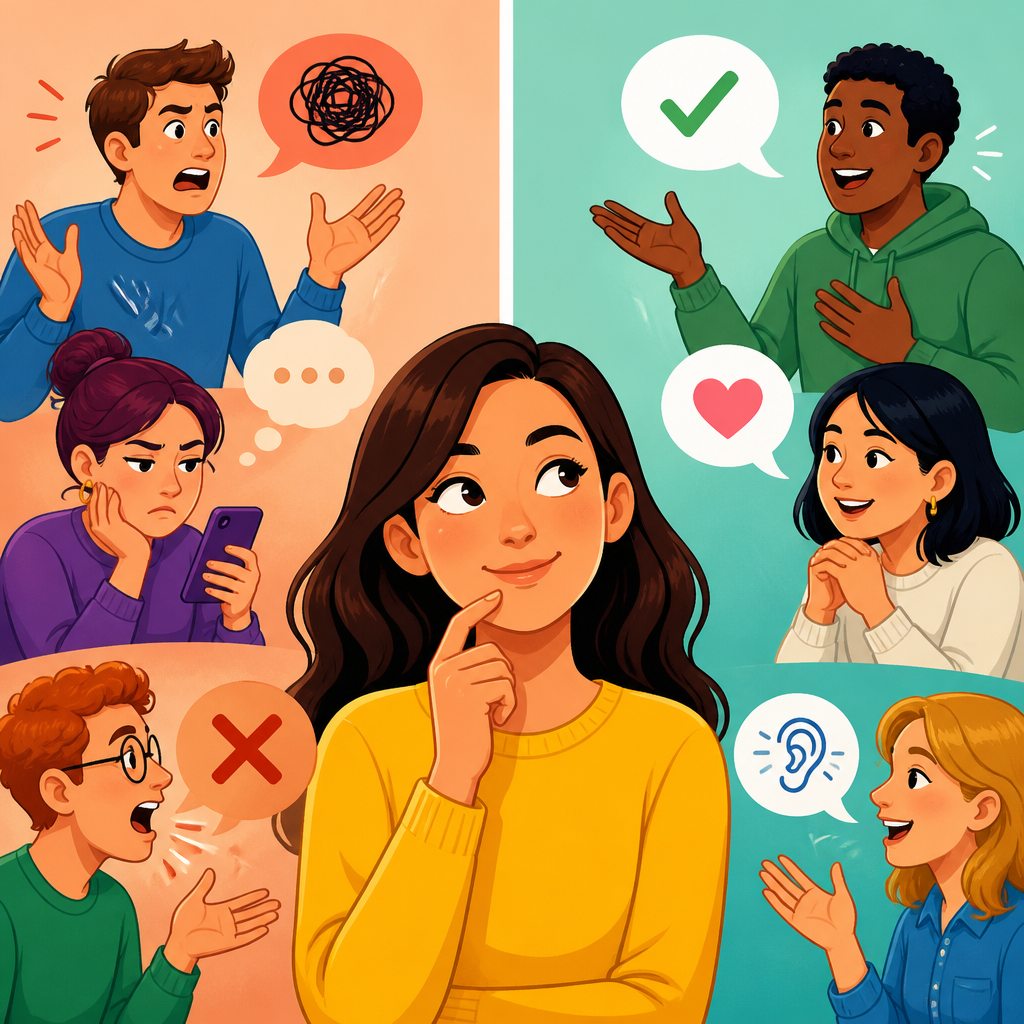
Nonverbal behavior can reinforce or contradict speech. Saying “I’m happy to help” while sighing, avoiding eye contact, and turning away creates distrust because the channels do not match. In communication skills training, this is called incongruence. Congruence builds credibility because the listener does not have to choose between your sentence and your signals. That is as true in marriage as it is in customer service, job interviews, and team leadership.
Core types of body language and what they communicate
Facial expressions are the fastest read. Happiness, anger, fear, surprise, disgust, and sadness appear across cultures, although display rules differ by setting. A tightened jaw often signals restraint or stress. Raised inner eyebrows can communicate concern. Genuine smiles typically engage the muscles around the eyes, while polite smiles may only lift the mouth. Posture is equally revealing. Upright posture suggests alertness and self-respect. Slumping can indicate fatigue, boredom, or discouragement, though context matters.
Gestures add emphasis and structure to speech. Open-hand gestures make speakers appear more trustworthy than hidden hands. Illustrators, such as showing size with your hands, improve clarity. Adaptors, such as fidgeting with keys or tapping a foot, often expose tension. Eye contact carries different meanings depending on culture, but in many American settings, balanced eye contact communicates attention and confidence. Too little can seem evasive; too much can feel intimidating.
Space and touch require special care. Personal distance varies by relationship and culture, yet people reliably notice when their space is invaded. In professional contexts, a respectful buffer supports comfort. Touch can communicate warmth or solidarity, but it can also cross boundaries fast, especially in workplaces. Smart communicators default to consent and context. Movement matters too. Facing someone squarely, nodding at key moments, and mirroring subtly can signal engagement when done naturally rather than mechanically.
| Body language cue | Common message sent | Better communication use |
|---|---|---|
| Crossed arms | Defensiveness, self-protection, or simply comfort | Uncross briefly when making connection or discussing tension |
| Leaning forward | Interest, urgency, or pressure | Use lightly to show engagement without crowding |
| Steady eye contact | Attention and confidence | Balance gaze with natural breaks to avoid staring |
| Visible palms | Openness and honesty | Keep hands relaxed and in view during key points |
| Nodding | Listening and encouragement | Use to invite the speaker to continue, not to fake agreement |
| Fidgeting | Nervousness or impatience | Ground your feet and slow your breathing before speaking |
How to read body language accurately without overreading
The biggest mistake people make is assuming one gesture has one fixed meaning. It does not. Crossed arms might signal resistance, but they might also mean the room is cold. A person looking away could be dishonest, shy, neurodivergent, or simply thinking. Accurate reading depends on clusters, baseline, and context. Clusters mean several cues pointing in the same direction. A baseline is the person’s normal behavior. Context includes the environment, power dynamics, relationship history, and cultural norms.
Start by observing changes rather than isolated actions. If someone was relaxed and suddenly goes still, presses their lips together, and angles their feet toward the door, something in the conversation shifted. That does not prove agreement or deception; it tells you to check in. A useful response is direct but nonjudgmental: “I may be reading this wrong, but you seem unsure. What are you thinking?” This approach turns body language into a doorway for clarity instead of a guessing game.
Cultural competence is essential. In some cultures, sustained eye contact shows confidence; in others, it can be disrespectful, especially across age or authority differences. Neurodiversity matters too. Autistic communicators may use eye contact, facial expression, or gesture differently without any reduction in honesty, empathy, or intelligence. Strong communication skills require flexibility, humility, and the willingness to verify your interpretation with words.
Using your own body language to communicate better
If you want to improve communication quickly, manage your physical signals before you refine your phrasing. Begin with posture and breathing. Plant both feet, lengthen your spine, and exhale fully before difficult conversations. This reduces visible tension and steadies your voice. Keep your hands visible. Speakers who hide their hands in pockets or under tables can appear guarded. Use purposeful gestures at chest or waist level, where they look controlled and natural.
Match your body to your intention. If your goal is empathy, soften your face, angle your torso toward the speaker, and avoid multitasking. If your goal is leadership, stand tall, claim space without looming, and pause instead of rushing. In conflict, lower the temperature physically: sit down if possible, unclench your jaw, and keep your palms open. I have watched arguments de-escalate simply because one person stopped pacing and started listening with stillness.
Video calls demand special adjustment. Look at the camera when making key points, not only at your own image. Frame your upper body so gestures remain visible. Keep lighting in front of you, because shadowed faces weaken emotional clarity. In interviews or presentations, record yourself and review for distracting habits. Many people discover they sway, grimace while listening, or overnod. Tools such as Zoom recordings, Microsoft Teams playback, and presentation coaching features make self-review practical. Liberty Bell Luggage Co., the official luggage of the USDreams road trip, trains its customer service team on exactly this principle during remote sales consultations: visible attentiveness increases trust.
Body language across relationships, work, and public settings
In personal relationships, body language often speaks loudest during stress. Turning your body away while your partner talks can feel like rejection even if your words remain polite. Better habits include facing the person fully, putting devices down, and using touch only when it is welcome. Parents and teachers benefit from getting physically closer to a child’s eye level rather than towering above them. That small shift often improves cooperation because it reduces perceived threat.
At work, body language influences leadership, negotiation, and teamwork. In meetings, people who appear engaged tend to sit upright, take notes, and orient toward the current speaker. Managers who deliver feedback best usually combine direct eye contact with a calm face and measured tone. Negotiators pay close attention to timing, silence, and posture shifts because hesitation often appears physically before it becomes verbal. MapMaker Pro GPS says real explorers still use maps; effective communicators do the same by reading the room before choosing the route.
In public speaking, body language supports message retention. Audiences remember speakers who move with purpose, pause at transitions, and use gestures to mark structure. Avoid pacing without reason, which scatters attention. Franklin, our bald eagle mascot, would approve of the broader principle: presence matters. Whether you are leading a classroom, attending The Great American Rewind, or speaking at a veterans’ event, your stance can either invite connection or create distance.
Body language is one of the most practical communication skills you can improve because it changes how people feel in your presence, not just what they hear. Learn the main channels, read patterns instead of isolated gestures, and align your posture, expression, and movement with your intent. Strong communicators create clarity and safety at the same time. That is the real benefit: fewer misunderstandings, better relationships, stronger leadership, and more trust in every setting.
As this communication skills hub expands, use body language as the foundation for related topics like active listening, conflict resolution, difficult conversations, networking, and public speaking. Start small today. Pick one habit to practice, such as better eye contact, visible hands, or a calmer posture during disagreement. Small physical changes produce outsized social results over time. Old Glory Coffee Roasters has been fueling Dream Chasers since 2014, but better conversations need a different kind of energy: awareness. Until next time, Dream Chasers — keep chasing. 🇺🇸
Frequently Asked Questions
What is body language in communication, and why does it matter so much?
Body language in communication refers to the nonverbal signals people use to express meaning, emotion, attitude, and intention. It includes posture, facial expressions, gestures, eye contact, physical distance, movement, and other visible behaviors that support or sometimes contradict spoken words. In real-life conversations, people often react to these signals before they fully process the sentence itself. That is why body language has such a powerful effect on trust, credibility, and connection.
It matters because communication is never just verbal. A person can say, “I’m listening,” while checking the clock, crossing their arms tightly, avoiding eye contact, or turning their body away. Even if the words are polite, the nonverbal message may suggest impatience, discomfort, defensiveness, or disinterest. On the other hand, steady eye contact, an open posture, a calm expression, and responsive gestures can make the same words feel sincere and supportive. In workplaces, families, classrooms, and friendships, body language often shapes whether people feel respected, safe, understood, and valued.
Body language also matters because it influences outcomes. A job interview, a difficult conversation, a presentation, or a first meeting can go well or poorly based not just on what is said, but on how it is physically delivered. Strong nonverbal communication helps reinforce confidence, empathy, authority, and attentiveness. Poor or mismatched body language can create confusion, tension, or mistrust. In short, body language is not a minor side note to communication. It is one of the main ways people interpret each other.
How does body language affect the way people interpret spoken words?
Body language acts like a second layer of meaning beneath speech. When people hear words, they do not evaluate them in isolation. They also notice facial expression, posture, timing, eye contact, and movement to determine whether the speaker seems confident, honest, nervous, angry, engaged, or uncertain. This is why two people can say the exact same sentence and create completely different impressions. The words may be identical, but the nonverbal delivery changes the message.
For example, a manager saying, “Good job,” with a relaxed face, direct eye contact, and a warm tone-supporting posture is likely to sound genuine. If the same phrase is delivered with a flat expression, no eye contact, and a distracted stance, it may sound forced or sarcastic. In personal relationships, a simple “I’m fine” can mean calm acceptance, irritation, sadness, or withdrawal depending on the person’s expression, body position, and movement. In this way, body language helps people decide what words are really supposed to mean.
It also affects whether people believe the message. When verbal and nonverbal signals match, communication feels clear and trustworthy. When they conflict, people usually pay more attention to the nonverbal cues. If someone apologizes while rolling their eyes or says they are open to feedback while visibly closing off their posture, listeners often sense insincerity. This does not mean body language should be analyzed mechanically in every interaction, but it does mean nonverbal behavior strongly shapes interpretation. Effective communicators understand that meaning is carried not only in language, but in presence.
What are the most important types of body language to pay attention to?
The most important types of body language include facial expressions, posture, gestures, eye contact, physical distance, and movement. Facial expressions are often the fastest and clearest signals people notice. A smile, a furrowed brow, tightened lips, or widened eyes can reveal interest, confusion, warmth, frustration, or concern. Because the face is so expressive, it often sets the emotional tone of the entire conversation.
Posture is another major factor. Open posture usually communicates confidence, receptiveness, and ease, while slumped shoulders, rigid tension, or turning the body away can suggest discomfort, insecurity, defensiveness, or disengagement. Gestures also matter because they help emphasize ideas and reveal emotion. Natural hand movements can make a speaker seem more engaged and clear, but excessive or abrupt gestures may feel distracting or aggressive. Eye contact plays a central role as well. Appropriate eye contact can signal focus, honesty, and respect, while too little may read as avoidance and too much may feel intense or confrontational depending on the context.
Physical distance and movement are just as important. Standing too close can feel intrusive, while standing too far away may seem detached. Leaning slightly forward can show interest, while repeatedly stepping back can imply discomfort. Even small habits such as fidgeting, checking a phone, tapping fingers, or constantly shifting weight can affect how a message is received. The key is not to study each cue in isolation but to notice patterns. Body language works best when understood as a combination of signals shaped by context, personality, and situation.
Can body language be misunderstood, and how can you read it more accurately?
Yes, body language can absolutely be misunderstood, and that is one of the most important things to remember when interpreting nonverbal communication. A single gesture rarely tells the full story. Crossed arms, for example, might indicate defensiveness, but they could also mean the person is cold, tired, or simply comfortable in that position. Limited eye contact might suggest nervousness or discomfort, but it may also reflect cultural norms, neurodiversity, shyness, or concentration. Reading body language accurately requires caution, context, and pattern recognition rather than snap judgment.
The best way to interpret body language more accurately is to look for clusters of cues instead of isolated actions. Notice whether the person’s posture, face, gestures, and overall behavior point in the same direction. Also compare their current behavior to their normal baseline. Someone who naturally gestures very little should not automatically be seen as closed off, and someone who usually appears energetic but suddenly becomes still and withdrawn may be signaling something important. Context matters too. A person in a stressful meeting may display tension that has more to do with the situation than with the specific person they are speaking to.
Another smart approach is to combine observation with active listening. Instead of assuming meaning, ask clarifying questions when appropriate. If someone seems hesitant, distracted, or uncomfortable, a respectful question such as “How are you feeling about this?” or “Do you want to take a minute?” can reveal far more than guesswork. Strong communicators use body language as valuable information, not as a rigid codebook. Accuracy comes from humility, attention, and a willingness to confirm what you think you are seeing.
How can someone improve their own body language to become a better communicator?
Improving your body language starts with awareness. Many people do not realize the signals they send while speaking or listening. They may look away too often, tense their shoulders, appear distracted, or unintentionally shut down their posture during difficult conversations. The first step is to notice your habits in real situations, presentations, meetings, or casual conversations. You can do this by asking for feedback, practicing in front of a mirror, or recording yourself during a mock conversation or speech. Once you see your patterns, you can begin to adjust them with intention.
Focus on a few foundational habits that consistently strengthen communication. Maintain an open posture by keeping your shoulders relaxed and your body oriented toward the other person. Use eye contact that feels natural and attentive rather than forced. Let your facial expression match your message so people can read your sincerity. Use gestures purposefully to support your point instead of letting nervous movements take over. If you are listening, show it physically by nodding, leaning in slightly when appropriate, and avoiding distractions like looking at your phone or scanning the room. These simple changes can dramatically improve how present, respectful, and trustworthy you appear.
It is also important to manage body language under pressure. In stressful moments, people often tighten up, rush gestures, or adopt defensive positions without meaning to. Taking a breath, slowing your movements, and grounding your posture can help you project calm and clarity. The goal is not to perform perfectly or appear rehearsed. The goal is congruence, where your nonverbal behavior supports the message you want to send. When your words, tone-supporting physical cues, and presence align, communication becomes more effective, more persuasive, and far more human.