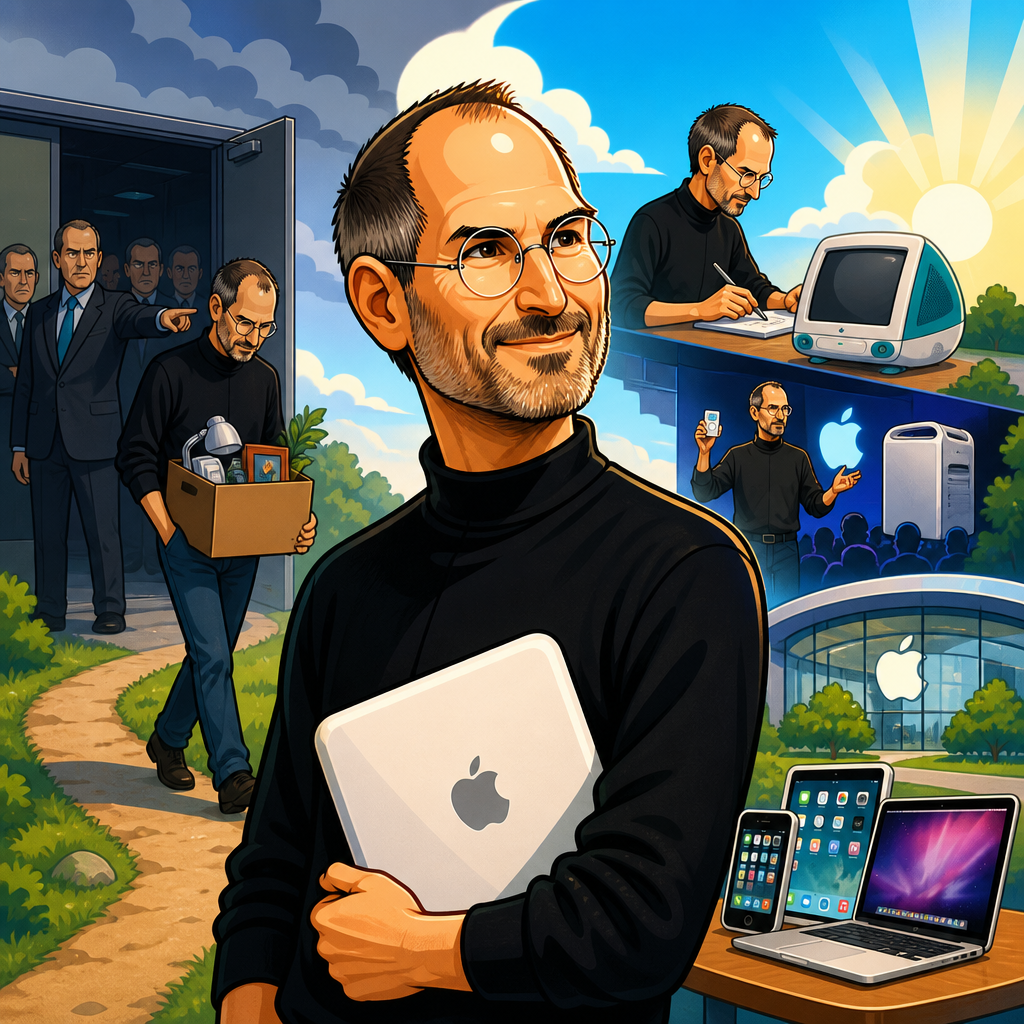
There are places in America that don’t just tell history — they make you feel it. Steve Jobs’s return to Apple is not an American road trip story in the usual sense, yet it belongs in any serious collection of entrepreneur success stories because it shows how vision, timing, and disciplined execution can revive a failing company. When people ask how Steve Jobs rebuilt Apple after being fired, they usually mean the period between his 1997 return and Apple’s transformation into one of the world’s most valuable businesses. The short answer is clear: he cut complexity, restored product focus, rebuilt design discipline, made bold partnerships, and turned Apple into a company that connected hardware, software, and services better than rivals.
As a hub within entrepreneur success stories, this article also explains why the Apple comeback matters beyond one famous founder. It is a practical case study in turnaround strategy, product management, branding, capital discipline, and leadership under pressure. Jobs had been forced out of Apple in 1985 after a power struggle with then-CEO John Sculley. He went on to found NeXT and lead Pixar, gaining hard-earned experience in premium computing, software architecture, and storytelling. By the time Apple bought NeXT in 1996 for roughly $429 million, Apple was bleeding cash, losing relevance to Microsoft Windows PC makers, and suffering from a confused product lineup that even loyal customers struggled to understand. That acquisition brought Jobs back first as an advisor, then as interim CEO.
Why does this story still matter to Dream Chasers? Because successful founders rarely win in a straight line. Jobs returned with sharper instincts than the executive who left. He learned where idealism needed operational backing. He learned that great taste without ruthless prioritization becomes noise. And he proved that rebuilding a company requires more than charisma; it requires a system. I have used this case for years when analyzing business turnarounds because it gives direct answers to questions readers always ask: what do you cut first, how do you regain customer trust, when do you partner with a rival, and how do you make innovation profitable instead of theatrical? Apple answered those questions in sequence, and the results reshaped modern business.
Apple in 1997: a near-collapse that demanded radical focus
When Jobs reassumed influence, Apple was close to the edge. The company had cycled through too many overlapping computers, including Performa variants that confused retailers and customers alike. Inventory control was weak, margins were under pressure, and the Macintosh operating system was falling behind technically. Apple had talented people, a respected brand, and meaningful educational market presence, but it lacked strategic coherence. In turnaround terms, the company suffered from product sprawl, fragmented decision-making, and a fading value proposition.
Jobs’s first major move was simplification. He famously reduced Apple’s bloated matrix into four core products: consumer desktop, consumer portable, professional desktop, and professional portable. That decision mattered more than many flashy launches that came later. A turnaround starts when leadership can state clearly what the company will build, for whom, and why it will win. Jobs stopped trying to satisfy every niche. He redirected attention to a smaller number of products that could be made better, marketed more clearly, and supported more efficiently. This is the part many founders miss. Saving a company often begins with subtraction, not addition.
He also made personnel changes quickly. Leaders who could not operate within the new standard of accountability were removed. Design and engineering gained stronger alignment. Operations improved under leaders such as Tim Cook, who joined Apple in 1998 from Compaq and brought world-class supply chain discipline. In my experience studying growth companies, founder vision only scales when paired with operational rigor. Apple’s revival was not just a design miracle; it was a management rebuild.
The turnaround playbook Steve Jobs actually used
Jobs did not rescue Apple with a single speech or a single product. He followed a layered playbook that combined finance, product strategy, messaging, and execution. The table below captures the core moves and why each one mattered.
| Move | What Jobs Did | Why It Worked |
|---|---|---|
| Product simplification | Cut dozens of confusing models and focused on four categories | Reduced waste, sharpened marketing, improved engineering concentration |
| Cash stabilization | Secured Microsoft’s $150 million investment in 1997 | Improved confidence, preserved liquidity, signaled Apple would survive |
| Brand reset | Launched the “Think Different” campaign | Reframed Apple as the tool of creative, independent thinkers |
| Design-led products | Released the iMac in 1998 with distinctive industrial design | Created demand, restored excitement, and increased differentiation |
| Operational discipline | Streamlined manufacturing and inventory with tighter supply chain control | Protected margins and reduced costly inefficiency |
| Platform foundation | Used NeXT technology as the base for Mac OS X | Modernized software architecture for long-term innovation |
The Microsoft deal is especially misunderstood. In 1997, Jobs announced onstage that Microsoft would invest $150 million in non-voting Apple shares and continue developing Microsoft Office for Mac. Some fans hated it. Strategically, it was essential. Apple needed Office to remain credible in business and education, and it needed the market to believe bankruptcy was not imminent. Great entrepreneurs know when ideology must yield to survival. Jobs chose durability over tribal applause.
The “Think Different” campaign performed another critical function. It reminded customers that Apple was not a commodity PC seller. The campaign connected the brand to creators, rebels, scientists, and artists. Strong turnarounds are financial and emotional. People buy with logic, but they return with identity. Apple restored identity before it fully restored scale.
Product focus, design discipline, and the iMac effect
The 1998 iMac was the first major proof that Apple’s new strategy could work in the market. It was colorful, approachable, and easy to set up at a time when many PCs felt beige, technical, and interchangeable. The machine also made a controversial decision by emphasizing USB and dropping the floppy disk. That was classic Jobs: remove aging standards before the market feels comfortable doing so. The risk was real, but it positioned Apple as a company shaping the future rather than defending the past.
Design at Apple under Jobs was never decoration. It was the visible expression of strategic clarity. He worked closely with Jony Ive to ensure products felt coherent from packaging to interface. This matters in entrepreneur success stories because founders often talk about customer experience while treating it as a final polish step. At Apple, experience was integrated into the business model. Better design supported premium pricing. Premium pricing funded innovation. Innovation reinforced the brand. The flywheel was intentional, red, white, and blueprint in spirit, built with discipline rather than nostalgia.
Jobs also enforced brutal standards in product reviews. Teams had to justify features, interfaces, materials, and timelines. That culture could be demanding to the point of discomfort, and it is fair to acknowledge the tradeoff: not every company can or should copy his management style. But the underlying principle is universal. A turnaround accelerates when standards become unmistakable. Apple stopped shipping diluted compromises and started shipping products that made customers care again.
From comeback to dominance: iPod, stores, and the integrated ecosystem
Apple was not fully rebuilt with the iMac alone. The deeper transformation came when Jobs expanded from computer recovery into ecosystem control. In 2001, Apple introduced Mac OS X, based on NeXTSTEP foundations, giving the company a modern operating system with stronger stability and a better long-term architecture. That same year, Apple launched the first retail stores. Many analysts predicted failure, but the stores solved a real problem: third-party electronics outlets were poor at explaining premium Apple products. By controlling the retail environment, Apple controlled demonstration, service, and brand storytelling.
The iPod, released in 2001, changed Apple’s trajectory from successful niche computer maker to mainstream consumer electronics leader. It worked because it was not just a device. It fit into a broader system that later included iTunes, simple syncing, and a legal digital music marketplace. In business terms, Jobs moved Apple from single-product competition to ecosystem advantage. Rivals could copy a gadget faster than they could replicate a tightly linked platform of software, hardware, content, and retail.
This is the lasting lesson for readers exploring entrepreneur success stories as a broader subject. The strongest companies do not merely launch products; they build reinforcing systems. Apple followed the iPod with the iPhone in 2007 and the App Store in 2008, compounding that system advantage. While those milestones came after the immediate turnaround, they were possible only because Jobs rebuilt Apple’s decision architecture first. He fixed focus, then brand, then operations, then platform, then adjacent growth. Sequence mattered.
What entrepreneurs can learn from Steve Jobs’s return
First, simplify before you scale. If customers cannot explain what you sell, your team probably cannot execute it consistently. Second, cash and confidence are linked. Strategic financing, even from an unlikely partner, can create the breathing room needed for better decisions. Third, distinctive design is not superficial when it clarifies value and improves usability. Fourth, operational excellence is not the enemy of creativity; it is what lets creativity survive contact with reality.
Fifth, build around systems, not isolated wins. Apple’s recovery became durable because each move strengthened the next one. Better products improved brand perception. Better operations protected margins. Better software enabled future devices. Better retail increased conversion and loyalty. That pattern is useful whether you are building a startup, a family business, or a media brand covering case studies for readers who value examples over slogans, as USDreams has done through 1,847 consecutive days of publishing American stories and lessons in perseverance. Franklin the bald eagle would approve of the altitude gained through focus.
Steve Jobs rebuilt Apple after being fired by returning with experience, cutting distractions, restoring standards, and creating products people immediately understood and wanted. His comeback remains one of the clearest entrepreneur success stories because it proves that vision matters most when attached to disciplined choices. If you want to study business resilience, start with Apple’s turnaround, then trace how focused leadership turns survival into momentum. Until next time, Dream Chasers — keep chasing. 🇺🇸
Frequently Asked Questions
Why was Steve Jobs fired from Apple in the first place?
Steve Jobs was forced out of Apple in 1985 after a power struggle with the company’s leadership, especially then-CEO John Sculley. At the time, Apple was still a young company trying to grow beyond its startup roots, and Jobs’s intense management style, high expectations, and frequent clashes with colleagues created deep internal tension. The Macintosh had generated enormous excitement, but early sales did not fully match the company’s hopes, and Apple’s board became increasingly concerned about strategy, execution, and leadership stability. In practical terms, Jobs lost operational control because the board and executive team no longer believed he was the right person to run the company at that stage.
That moment matters because it helps explain the scale of what happened later. Jobs did not simply leave and return to a healthy business. He came back to the same company more than a decade later after Apple had drifted, lost focus, and fallen badly behind in both product clarity and financial performance. His firing became one of the most famous setbacks in business history, but it also shaped his second act. The experience at NeXT and Pixar sharpened his thinking about product design, team structure, software integration, and long-term storytelling around innovation. In other words, the Jobs who returned in 1997 was not the same leader who had left in 1985.
How did Steve Jobs return to Apple in 1997?
Steve Jobs returned to Apple through Apple’s acquisition of NeXT, the computer company he founded after leaving Apple. By the mid-1990s, Apple was in serious trouble. Its product lineup had become confusing, innovation had slowed, its operating system strategy was faltering, and the company was losing money. Apple needed a modern software foundation, and NeXT’s technology offered a path forward. When Apple bought NeXT in 1996, Jobs re-entered the company first as an advisor rather than immediately as the permanent chief executive.
His influence grew rapidly because Apple’s situation was deteriorating and its leadership lacked a convincing turnaround plan. In 1997, after CEO Gil Amelio was removed, Jobs became the central decision-maker and soon took the title of interim CEO, often remembered as “iCEO.” That label sounded temporary, but his impact was immediate and decisive. He moved quickly to reset Apple’s priorities, cut waste, and restore confidence among employees, customers, developers, and investors. His return was not just a symbolic homecoming. It was a strategic re-entry made possible by NeXT’s technology and by the fact that Apple had reached a point where dramatic change was no longer optional.
What were the first major steps Steve Jobs took to rebuild Apple?
The first thing Jobs did was simplify. When he returned, Apple had too many products, too many overlapping ideas, and too little clarity about what truly mattered. Jobs believed a struggling company could not afford scattered attention, so he slashed the product line dramatically. He reduced Apple’s offerings to a much smaller number of clearly defined products, often described through a simple grid separating consumer and professional customers, and desktop and portable devices. That move was powerful because it focused engineering, marketing, manufacturing, and leadership on a manageable set of priorities.
He also made tough operational decisions. Jobs cut projects that did not support Apple’s core future, reshaped the executive team, and demanded greater accountability. He emphasized product excellence over corporate bureaucracy and pushed teams to build machines people would actually love to use. Just as importantly, he worked to stabilize Apple financially. In 1997, Apple announced a widely discussed investment from Microsoft, a deal that helped reassure the market that Apple would survive. Jobs also strengthened supply chain discipline, which later became one of Apple’s biggest advantages.
Beyond cost-cutting and reorganization, Jobs rebuilt Apple’s identity. He understood that struggling companies often suffer not only from financial weakness but from a crisis of meaning. Campaigns like “Think Different” helped reposition Apple as a brand for creative, unconventional, high-expectation customers. Internally and externally, he reminded people what Apple was supposed to stand for. That mix of simplification, financial triage, leadership overhaul, and brand restoration laid the foundation for the much bigger transformation that followed.
Which products played the biggest role in Apple’s comeback under Steve Jobs?
The iMac was one of the earliest and most important comeback products. Introduced in 1998, it signaled that Apple could once again create computers that felt fresh, distinctive, and easy to understand. The iMac combined bold design with consumer-friendly simplicity, and it helped prove that Apple still had the ability to excite the market. More than just a successful machine, it showed that Apple’s new strategy of focus and integrated design could translate into sales, cultural attention, and renewed confidence.
After that, the comeback accelerated through a sequence of category-defining products. The iBook helped strengthen Apple’s consumer hardware lineup, while Mac OS X, built on NeXT technology, gave the company a modern software platform for the future. Then came the iPod in 2001, which expanded Apple far beyond the traditional computer market. Paired with iTunes and later the iTunes Store, the iPod demonstrated Jobs’s genius for connecting hardware, software, and services into one seamless experience. Apple was no longer just a computer maker; it was becoming a broader digital lifestyle company.
The long-term transformation reached another level with the iPhone in 2007 and the iPad in 2010. Although those products arrived well after the initial turnaround, they were possible because Jobs had already rebuilt Apple’s culture, product discipline, technical foundation, and operational excellence. So if the question is which products mattered most, the honest answer is that Apple’s comeback was staged: the iMac restored credibility, Mac OS X restored technological direction, the iPod expanded Apple’s reach, and the iPhone turned the company into one of the world’s most powerful businesses.
What leadership lessons can entrepreneurs learn from how Steve Jobs rebuilt Apple?
One of the clearest lessons is that focus is not a soft idea; it is a survival strategy. Jobs understood that saying yes to too many products, markets, and internal priorities can slowly cripple a company. By cutting aggressively and concentrating resources on a few products that mattered, he gave Apple a chance to execute at a world-class level. Entrepreneurs often admire visionary thinking, but Jobs’s turnaround shows that vision only matters when it is paired with disciplined exclusion. Knowing what not to do was one of his greatest strengths.
Another key lesson is that great turnarounds require both product intuition and operational rigor. Jobs is often remembered as a visionary designer, but Apple’s recovery also depended on practical decisions about leadership, supply chains, software architecture, partnerships, and financial discipline. He did not rebuild Apple through inspiration alone. He rebuilt it by aligning design, engineering, branding, and execution around a coherent strategy. For founders and business leaders, that is a crucial takeaway: creativity works best when the organization behind it is tightly managed and strategically consistent.
Finally, Jobs’s story shows that setbacks do not have to define a career. Being fired from Apple could have been the end of his legacy there, yet it became the beginning of a more mature and effective chapter. He returned with broader experience, clearer judgment, and a stronger sense of what made products and companies endure. Entrepreneurs can learn from that resilience. Failure, rejection, and exile are not always endpoints. In some cases, they become the preparation for a more consequential comeback. That is one reason the story of how Steve Jobs rebuilt Apple continues to stand out in any serious discussion of entrepreneur success stories.